
Heat output from the south polar region of Saturn's moon Enceladus is much greater than was previously thought possible, according to a new analysis of data collected by NASA's Cassini spacecraft. The study was published in the Journal of Geophysical Research on March 4. Data from Cassini's composite infrared spectrometer of Enceladus' south polar terrain, which is marked by linear fissures, indicate that the internal heat-generated power is about 15.8 gigawatts, approximately 2.6 times the power output of all the hot springs in the Yellowstone region, or comparable to 20 coal-fueled power stations. This is more than an order of magnitude higher than scientists had predicted, according to Carly Howett, the lead author of study, who is a postdoctoral researcher at Southwest Research Institute in Boulder, Colo., and a composite infrared spectrometer science team member.
"The mechanism capable of producing the much higher observed internal power remains a mystery and challenges the currently proposed models of long-term heat production," said Howett. It has been known since 2005 that Enceladus' south polar terrain is geologically active and the activity is centered on four roughly parallel linear trenches, 130 kilometers (80 miles) long and about 2 kilometers (1 mile) wide, informally known as the "tiger stripes." Cassini also found that these fissures eject great plumes of ice particles and water vapor continually into space. These trenches have elevated temperatures due to heat leaking out of Enceladus' interior.
A 2007 study predicted the internal heat of Enceladus, if principally generated by tidal forces arising from the orbital resonance between Enceladus and another moon, Dione, could be no greater than 1.1 gigawatts averaged over the long term. Heating from natural radioactivity inside Enceladus would add another 0.3 gigawatts. The latest analysis, which also involved the composite infrared spectrometer team members John Spencer at Southwest Research Institute, and John Pearl and Marcia Segura at NASA's Goddard Space Flight Center in Greenbelt, Md., uses observations taken in 2008, which cover the entire south polar terrain. They constrained Enceladus' surface temperatures to determine the region's surprisingly high output.

NASA's Mars Science Laboratory rover, Curiosity, will carry a next generation, onboard "chemical element reader" to measure the chemical ingredients in Martian rocks and soil. The instrument is one of 10 that will help the rover in its upcoming mission to determine the past and present habitability of a specific area on the Red Planet. Launch is scheduled between Nov. 25 and Dec. 18, 2011, with landing in August 2012. The Alpha Particle X-Ray Spectrometer (APXS) instrument, designed by physics professor Ralf Gellert of the University of Guelph in Ontario, Canada, uses the power of alpha particles, or helium nuclei, and X-rays to bombard a target, causing the target to give off its own characteristic alpha particles and X-ray radiation. This radiation is "read by" an X-ray detector inside the sensor head, which reveals which elements and how much of each are in the rock or soil.
Identifying the elemental composition of lighter elements such as sodium, magnesium or aluminum, as well as heavier elements like iron, nickel or zinc, will help scientists identify the building blocks of the Martian crust. By comparing these findings with those of previous Mars rover findings, scientists can determine if any weathering has taken place since the rock formed ages ago. All NASA Mars rovers have carried a similar instrument Pathfinder's rover Sojourner, Spirit and Opportunity, and now Curiosity, too. Improvements have been made with each generation, but the basic design of the instrument has remained the same.
"APXS was modified for Mars Science Laboratory to be faster so it could make quicker measurements. On the Mars Exploration Rovers it took us five to 10 hours to get information that we will now collect in two to three hours," said Gellert, the intrument's principal investigator. “We hope this will help us to investigate more samples.” Another significant change to the next-generation APXS is the cooling system on the X-ray detector chip. The instruments used on Spirit and Opportunity were able to take measurements only at night. But the new cooling system will allow the instrument on Curiosity to take measurements during the day, too.

NASA's Cassini spacecraft is set to skim close to Saturn's moon Titan on Friday, Feb. 18, to learn about the interaction between Titan and Saturn's magnetosphere, the magnetic bubble around the planet. The closest approach will take place at 8:04 a.m. PST (4:04 p.m. UTC) and bring Cassini within about 3,650 kilometers (2,270 miles) of Titan's surface. As Titan makes a complete 360-degree orbit around Saturn, the relative influence of the sun's illumination and the hot ionized gas trapped in the magnetic bubble changes. These factors are important for understanding the relationship between Titan and Saturn's magnetosphere. It is important to make measurements at a variety of locations in the Saturn magnetosphere, so this flyby will occur in a part of the magnetosphere that has been poorly sampled so far.
Previous flybys have shown the magnetic environment near Titan to be rather variable and unpredictable. For 12 hours before and after closest approach, the Cassini plasma spectrometer instrument will be pointing in a direction to capture ionized gas in the region. At the same time, Cassini's radio science subsystem will be gathering sensitive gravity data from Titan to improve understanding of the structure of the interior. Collecting data like these will eventually enable scientists to determine whether Titan has an ocean under its crust. Other instruments will also be collecting data, much of it pertaining to seasonal change.
Titan is currently in northern spring, approaching northern summer, and scientists want to know what has changed with the north polar winter vortex weather pattern. The composite infrared spectrometer, for instance, will be mapping temperatures in Titan's stratosphere. The imaging science subsystem will also be monitoring the lakes, clouds and transport of aerosols in the Titan atmosphere. This latest flyby is dubbed "T74," though planning changes early in the orbital tour have made this the 75th targeted flyby of Titan. The Cassini-Huygens mission is a cooperative project of NASA, the European Space Agency and the Italian Space Agency. NASA's Jet Propulsion Laboratory, Pasadena, Calif., a division of the California Institute of Technology in Pasadena, manages the mission for NASA's Science Mission Directorate, Washington, D.C. The Cassini orbiter was designed, developed and assembled at JPL.

The yearly depletion of stratospheric ozone over Antarctica more commonly referred to as the “ozone hole” started in early August 2010 and is now expanding toward its annual maximum. The hole in the ozone layer typically reaches its maximum area in late September or early October, though atmospheric scientists must wait a few weeks after the maximum to pinpoint when the trend of ozone depletion has slowed down and reversed. The hole isn’t literal; no part of the stratosphere the second layer of the atmosphere, between 8 and 50 km is empty of ozone. Scientists use "hole" as a metaphor for the area in which ozone concentrations drop below the historical threshold of 220 Dobson Units. Historical levels of ozone were much higher than 220 Dobson Units, according to NASA atmospheric scientist Paul Newman, so this value shows a very large ozone loss.
Earth's ozone layer protects life by absorbing ultraviolet light, which damages DNA in plants and animals (including humans) and leads to skin cancer. The Ozone Monitoring Instrument (OMI) on NASA’s Aura satellite acquired data for this map of ozone concentrations over Antarctica on September 12, 2010. OMI is a spectrometer that measures the amount of sunlight scattered by Earth’s atmosphere and surface, allowing scientists to assess how much ozone is present at various altitudes particularly the stratosphere and near the ground. So far in 2010, the size and depth of the ozone hole has been slightly below the average for 1979 to 2009, likely because of warmer temperatures in the stratosphere over the far southern hemisphere.
Even slight changes in the meteorology of the region this month could affect the rate of depletion of ozone and how large an area the ozone hole might span. You can follow the progress of the ozone hole by visiting NASA’s Ozone Hole Watch page. September 16 is the International Day for the Preservation of the Ozone Layer, a commemoration of the day in 1987 when nations commenced the signing of the Montreal Protocol to limit and eventually ban ozone-depleting substances such as chlorofluorocarbons (CFCs) and other chlorine and bromine-containing compounds. The ozone scientific assessment panel for the United Nations Environment Program, which monitors the effectiveness of the Montreal Protocol, is expected to release its latest review of the state of the world’s ozone layer by the end of 2010. Newman is one of the four co-chairs of the assessment panel.

NASA's Mars rover Curiosity has been exercising its robotic arm since last month, when the arm was first fastened to the rover. In the long run, watch for this long and strong arm to become the signature apparatus of NASA's Mars Science Laboratory. After landing in August 2012, the mission will rely on it for repeated research activities. One set of moves crucial to the mission's success has never been tried before on Mars: pulling pulverized samples from the interior of Martian rocks and placing them into laboratory instruments inside the rover. Engineers and technicians are putting the arm through a range of motions this month in the clean room where Curiosity is being assembled and tested at NASA's Jet Propulsion Laboratory, Pasadena, Calif.
"We're fine-tuning the ability to make the arm go exactly where we want it to go," said JPL's Brett Kennedy, cognizant engineer for the robotic arm. "Next, we'll start pushing on things with the arm." The arm can extend about 2.3 meters (7.5 feet) from the front of the rover body. Still to be added: the turret at the end that holds a percussive drill and other tools weighing a total of about 33 kilograms (73 pounds). "This arm is strong, but still needs to move accurately enough to drop an aspirin tablet into a thimble," Kennedy said. The titanium arm has two joints at the shoulder, one at the elbow and two at the wrist. Each joint moves with a cold-tolerant actuator, custom-built for the mission.
The tools to be wielded by the arm include a magnifying-lens camera; an element-identifying spectrometer; a rock brush; and mechanisms for scooping, sieving and portioning samples. The mission is designed to operate on Mars for a full Martian year, which equals about two Earth years. MDA Information Systems Inc.'s Space Division in Pasadena built and tested the arm, incorporating actuators from Aeroflex Corp., Plainview, N.Y. JPL, a division of the California Institute of Technology in Pasadena, manages the Mars Science Laboratory Project for the NASA Science Mission Directorate, Washington.
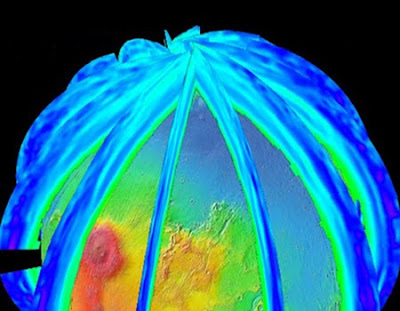
One of the instruments on a 2016 mission to orbit Mars will provide daily maps of global, pole-to-pole, vertical distributions of the temperature, dust, water vapor and ice clouds in the Martian atmosphere. The joint European-American mission, ExoMars Trace Gas Orbiter, will seek faint gaseous clues about possible life on Mars. This instrument, called the ExoMars Climate Sounder, will supply crucial context with its daily profiling of the atmosphere's changing structure. The European Space Agency and NASA have selected five instruments for ExoMars Trace Gas Orbiter. The European Space Agency will provide one instrument and the spacecraft. NASA will provide four instruments, including ExoMars Climate Sounder, which is coming from NASA's Jet Propulsion Laboratory, Pasadena, Calif.
Two of the other selected instruments are spectrometers one each from Europe and the United States designed to detect very low concentrations of methane and other important trace gases in the Martian atmosphere. "To put the trace-gas measurements into context, you need to know the background structure and circulation of the atmosphere," said JPL's Tim Schofield, principal investigator for the ExoMars Climate Sounder. "We will provide the information needed to understand the distribution of trace gases identified by the spectrometers. We'll do this by characterizing the role of atmospheric circulation and aerosols, such as dust and ice, in trace-gas transport and in chemical reactions in the atmosphere affecting trace gases."
The ExoMars Climate Sounder is an infrared radiometer designed to operate continuously, day and night, from the spacecraft's orbit about 400 kilometers (about 250 miles) above the Martian surface. It can pivot to point downward or toward the horizon, measuring temperature, water vapor, dust and ices for each 5-kilometer (3-mile) increment in height throughout the atmosphere from ground level to 90 kilometers (56 miles) altitude. Schofield and his international team have two other main goals for the investigation, besides aiding in interpretation of trace-gas detections. One is to extend the climate mapping record currently coming from a similar instrument, the Mars Climate Sounder, on NASA's Mars Reconnaissance Orbiter, which has been working at Mars since 2006.
View this site : Property auctions

Interview footage of two NASA astronauts scheduled next year to become the first twins to rendezvous in space is available on NASA Television and the agency's website. Mark Kelly will command the last scheduled space shuttle flight, while his twin brother Scott Kelly will be in command of the International Space Station. During the interview, they discuss growing up in West Orange, N.J., their paths to becoming astronauts, and the possibilities of a joint mission in space. The Kellys, both captains in the U.S. Navy, were born Feb. 21, 1964, in Orange, N.J. Scott has flown on two prior shuttle missions, as pilot of STS-103 in 1999 and commander of STS-118 in 2007. Mark is a veteran of three prior shuttle missions, as pilot of STS-108 in 2001 and STS-121 in 2006, and commander of STS-124 in 2008.
Scott is scheduled to launch to the space station aboard a Russian Soyuz spacecraft from the Baikonur Cosmodrome in Kazakhstan on Oct. 7 for a six-month-long mission aboard the complex. He will serve as flight engineer for Expedition 25 and commander for Expedition 26. Mark, commander of shuttle Endeavour's STS-134 mission, is scheduled to visit the station in February to deliver supplies and the Alpha Magnetic Spectrometer. The device will study the universe's origin by searching for antimatter, dark matter, and strange matter, and by measuring cosmic rays. If the launch schedule doesn't change, the pair would be working together in orbit for eight days before the shuttle undocks and returns to Earth.

NASA's Cassini spacecraft has returned Saturnian moon images from its flyby late last week, revealing light and dark contrasts worthy of chiaroscuro painters like Caravaggio. The flyby on August 13 targeted the geyser moon Enceladus, but also brought Cassini close to two other moons Tethys and Dione. The raw images include the best ones to date of Penelope crater on the icy moon Tethys. Penelope crater, which is 150 kilometers (90 miles) wide, is the second-largest crater on Tethys. Cassini was also able to obtain a portrait of Enceladus over the bright arc of Saturn's atmosphere and a moody still life of one of the "tiger stripe" fissures at the Enceladus south polar region on the cusp of darkness.
This particular "tiger stripe" which is the nickname for the fissures spewing water vapor and organic particles out into space is called Damascus Sulcus. It was also the subject of a heat scan by Cassini's composite infrared spectrometer. Scientists are still analyzing the results. Images of Dione highlight the moon's battered surface. The Cassini-Huygens mission is a cooperative project of NASA, the European Space Agency and the Italian Space Agency. JPL, a division of the California Institute of Technology in Pasadena, manages the mission for NASA's Science Mission Directorate, Washington, D.C. The Cassini orbiter and its two onboard cameras were designed, developed and assembled at JPL. The imaging operations center is based at the Space Science Institute in Boulder, Colo.
 NASA's Cassini spacecraft will be hunting for heat signatures at the "tiger stripes" in the dim south polar region of Saturn's moon Enceladus on Friday, Aug. 13. The closest approach will bring the spacecraft to within about 2,500 kilometers (1,600 miles) of the surface of Enceladus. The tiger stripes which are actually giant fissures that spew jets of water vapor and organic particles hundreds of kilometers, or miles, out into space - are hard to see in the visible-light spectrum because winter is beginning to darken the moon's southern hemisphere. Cassini, however, has its own version of "night vision goggles" the composite infrared spectrometer instrument which can track heat even when visible light is low. The instrument will map temperatures in the transverse fractures between the tiger stripes Cairo Sulcus and Alexandria Sulcus. It will also scan part of the tiger stripe Damascus Sulcus.
The relatively high flyby allows the composite infrared spectrometer to track the tiger stripe surface smoothly throughout the flyby. That kind of coverage is more difficult at lower altitudes because the surface whooshes by very quickly. In addition, the visual and infrared mapping spectrometer will collect data on the composition of Enceladus, and the imaging cameras will take pictures. The Cassini-Huygens mission is a cooperative project of NASA, the European Space Agency and the Italian Space Agency. The Jet Propulsion Laboratory, a division of the California Institute of Technology in Pasadena, manages the Cassini-Huygens mission for NASA's Science Mission Directorate in Washington. The Cassini orbiter was designed, developed and assembled at JPL.

NASA personnel are among a group of international researchers who are in the Canadian Arctic assessing concepts for future planetary exploration as part of the Haughton Mars Project, or HMP-2010.Scientists are using the arid, rocky environment of the Haughton Crater on Devon Island, Canada to simulate conditions that might be encountered by explorers on other planetary bodies. The latest edition of the HMP-2010 began July 19 and includes three weeks of crew and mission control activities and robotic testing.
"Explorers, such as geologists, often find themselves with a set of observations they would have liked to make, or samples they would have liked to take, if only they had been able to stay longer at a site," said Terry Fong, director of the Intelligent Robotics Group at NASA's Ames Research Center in Moffett Field, Calif. "Our work this year is to study how remotely operated robots, perhaps even vehicles previously used for crew transport, can be used to perform follow-up work."
Using robots for such follow-up work could save astronauts from performing tedious, repetitive or time-consuming activities. Surveying a site could take hundreds to thousands of readings using ground-penetrating radar, spectrometers, or geotechnical instruments. Additionally, robots could make measurements and take pictures that complement or supplement those initially taken by humans. Mission planners speculate that in the future, there could be substantial amounts of time between crewed missions for robots to perform research work at a range of destinations.

As American schoolchildren head out to pools for a summer splash, NASA's Cassini spacecraft will be taking its own deep plunge through the Titan atmosphere this week. The altitude for the upcoming Titan flyby, whose closest approach occurs in the evening of July 6, Pacific and Eastern time will be about 125 kilometers higher than the super-low flyby of June 21. The altitude of this flyby 1,005 kilometers is still considered a low dip into Titan's atmosphere. Cassini will not go lower again until May 2012.
During closest approach, Cassini's ion and neutral mass spectrometer will be sniffing out the chemical composition of Titan's atmosphere to refine estimates of the densities of nitrogen and methane there. The radar instrument will be mapping an area south of the dark region known as Senkyo and the Belet sand seas. It is an area that had not been well studied by radar until this flyby. Because the geometry of this flyby is similar to the previous one, the magnetometer and other instruments measuring the magnetic bubble around Saturn will be conducting similar experiments.
Though the magnetometer will be too high to detect any whisper of an internal magnetic field from Titan – which was the focus of the search on the last flyby scientists will be looking into the interaction of Titan's atmosphere with the magnetic bubble around Saturn. This latest flyby is dubbed "T71," though planning changes early in the orbital tour have made this the 72nd targeted flyby of Titan.

Complex interactions between Saturn and its satellites have led scientists using NASA's Cassini spacecraft to a comprehensive model that could explain how oxygen may end up on the surface of Saturn's icy moon Titan. The presence of these oxygen atoms could potentially provide the basis for pre-biological chemistry.
The interactions are captured in two papers, one led by John Cooper and another led by Edward Sittler, published in the journal Planetary and Space Science in late 2009. Cooper and Sittler are Cassini plasma spectrometer team scientists at NASA's Goddard Space Flight Center in Greenbelt, Md. "Titan and Enceladus, another icy moon of Saturn, are chemically connected by the flow of material through the Saturn system," Cooper said.
In one paper, Cooper and colleagues provide an explanation for forces that could generate the Enceladus geysers that spew water vapor into space. In the other, published in the same issue, Sittler and colleagues describe a unique new process in which oxygen that circulates in the upper atmosphere of Titan can be carried all the way to the surface without further chemical contamination by being encased in carbon cages called fullerenes.

Mars rover team members have begun informally naming features around the rim of Endeavour Crater, as they develop plans to investigate that destination when NASA's Opportunity rover arrives there after many more months of driving. A new, super-resolution view of a portion of Endeavour's rim reveals details that were not discernible in earlier images from the rover. Several high points along the rim can be correlated with points discernible from orbit.
Super-resolution is an imaging technique combining information from multiple pictures of the same target to generate an image with a higher resolution than any of the individual images. Endeavour has been the team's long-term destination for Opportunity since the summer of 2008, when the rover finished two years of studying Victoria Crater. By the spring of 2010, Opportunity had covered more than a third of the charted, 19-kilometer (12-mile) route from Victoria to Endeavour and reached an area with a gradual, southward slope offering a view of Endeavour's elevated rim.
After the rover team chose Endeavour as a long-term destination, the goal became even more alluring when observations with the Compact Reconnaissance Imaging Spectrometer for Mars, on NASA's Mars Reconnaissance Orbiter, found clay minerals exposed at Endeavour. Clay minerals, which form under wet conditions, have been found extensively on Mars from orbit, but have not been examined on the surface. Additional observations with that spectrometer are helping the rover team choose which part of Endeavour's rim to visit first with Opportunity.


