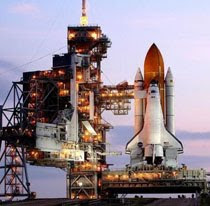
 NASA managers have set the liftoff of space shuttle Endeavour for 8:56 a.m. EDT on Monday, May 16. Launch attempts are available through May 26, except for May 21. The STS-134 mission to the International Space Station is the penultimate shuttle flight and the final one for Endeavour. Space Shuttle Program Launch Integration Manager Mike Moses and Shuttle Launch Director Mike Leinbach announced the date at a news briefing Monday from NASA's Kennedy Space Center in Florida. They also discussed the progress of repairs since Endeavour's launch postponement on April 29.
A short in the heater circuit associated with Endeavour's hydraulic system resulted in the launch postponement. Technicians determined the most likely failure was inside a switchbox in the shuttle's aft compartment and associated electrical wiring connecting the switchbox to the heaters. The heater circuits prevent freezing of the fuel lines providing hydraulic power to steer the vehicle during ascent and entry. The faulty box was replaced May 4. Since Friday, Kennedy technicians installed and tested new wiring that bypasses the suspect electrical wiring and confirmed the heater system is working properly. They also are completing retests of other systems powered by the switchbox and are closing out Endeavour's aft compartment.
STS-134 Commander Mark Kelly and his five crewmates are set to arrive at Kennedy for prelaunch preparations on Thursday, May 12, at approximately 11 a.m. NASA Television will broadcast the crew's arrival live. The crew will deliver the Alpha Magnetic Spectrometer-2 (AMS) and critical supplies to the space station, including two communications antennas, a high-pressure gas tank and additional parts for the Dextre robot. AMS is a particle physics detector designed to search for various types of unusual matter. The crew also will transfer Endeavour's orbiter boom sensor system to the station, where it could assist spacewalkers as an extension for the station's robotic arm.

NASA Administrator Charles Bolden will commemorate the 50th anniversary of the first U.S. manned spaceflight during two events this week around the agency's Kennedy Space Center in Florida. NASA Television will carry both events live. On Wednesday, May 4, at 2 p.m. EDT, the U.S. Postal Service will unveil two new stamps at the Rocket Garden of the Kennedy Space Center Visitor Complex, located on State Road 405. Journalists interested in covering the event should contact Andrea Farmer at 321-449-4318 or Jillian McRae at 321-449-4273. Media need to arrive at least 30 minutes before the start of the ceremony.
One stamp commemorates NASA's Project Mercury and Alan Shepard's historic launch on May 5, 1961 aboard the spacecraft Freedom 7. The second stamp honors NASA's MESSENGER, which reached Mercury in March to become the first spacecraft to orbit the planet. The two missions frame a remarkable 50-year period in which America advanced space exploration through more than 1,500 manned and unmanned flights. Mercury astronaut Scott Carpenter and members of the Shepard family will join Bolden at the stamps' unveiling and at a 50th anniversary ceremony on Thursday, May 5, at 9 a.m., at the Cape Canaveral Air Force Station.
To cover the event, news media representatives need to be at the Air Force Badging Office (Gate 1) at 6:30 a.m. for transportation to Complex 5/6. Mission badges for the STS-134 shuttle mission will be honored for this event. Reporters who do not have one must contact Christopher Calkins at 321-494-7732 or Auburn Davis at 321-494-6489 to arrange for media credentials. The Thursday event includes a re-creation of Shepard's flight and recovery, as well as a tribute to his contributions as a moonwalker on the Apollo 14 lunar mission. KSC Director and former astronaut Bob Cabana and more than 200 workers from the original Mercury program, also will be in attendance.

NASA's Glory spacecraft is scheduled for launch on Friday, March 4. Technical issues with ground support equipment for the Taurus XL launch vehicle led to the scrub of the original Feb. 23 launch attempt. Those issues have been resolved. The liftoff from Vandenberg Air Force Base in California is targeted for 5:09:43 a.m. EST, in the middle of a 48-second launch window. Spacecraft separation occurs 13 minutes after launch. Coverage of the countdown on the Glory launch blog and on NASA TV will begin on launch day at 3:30 a.m. EST. Data from the Glory mission will allow scientists to better understand how the sun and tiny atmospheric particles called aerosols affect Earth's climate.
Both aerosols and solar energy influence the planet's energy budget the amount of energy entering and exiting Earth's atmosphere. An accurate measurement of these impacts is important in order to anticipate future changes to our climate and how they may affect human life. Project management for Glory is the responsibility of NASA's Goddard Space Flight Center in Greenbelt, Md. The launch management for the mission is the responsibility of NASA's Launch Services Program at the Kennedy Space Center in Florida. Orbital Sciences Corp. of Dulles, Va., is the launch service provider to Kennedy of the four-stage Taurus XL rocket and is also builder of the Glory satellite for Goddard.

NASA has taken the next step toward a new generation of Deep Space Network antennas. A $40.7 million contract with General Dynamics SATCOM Technologies, San Jose, Calif., covers implementation of two additional 34-meter (112-foot) antennas at Canberra, Australia. This is part of Phase I of a plan to eventually retire the network's aging 70-meter-wide antennas. The Deep Space Network (DSN) consists of three communications complexes: in Goldstone, Calif.; Madrid, Spain; and Canberra, Australia. The 70-meter antennas are more than 40 years old and are showing signs of surface deterioration from constant use. Additional 34-meter antennas are being installed in Canberra in the first phase; subsequent phases will install additional 34-meter antennas in Goldstone and Madrid.
The 34-meter beam waveguide antennas are essential to keep communications flowing smoothly as NASA's fleet of spacecraft continues to expand. In addition, the waveguide design of the antennas provides easier access for maintenance and future upgrades, because sensitive electronics are housed in a below-the-ground pedestal equipment room, instead of in the center of the dish. "As a result of several studies, it was determined that arrays of 34-meter beam waveguide antennas were the best solution to long-term continuation of DSN 70-meter capabilities," said Miguel Marina, who manages the 70-meter replacement task force at NASA's Jet Propulsion Laboratory in Pasadena, Calif. "The new antennas are critical communication resources for all current and future NASA missions."
NASA expects to complete the building of the first two 34-meter antennas in Canberra by 2016. They will be named Deep Space Stations 35 and 36. Deep Space Station 35 is due to be online in 2014, and Deep Space Station 36 is expected to follow in 2016. In 1958, NASA established the Deep Space Network as a separately managed and operated communications facility to accommodate all deep space missions. This avoided the need for each flight project to acquire its own specialized space communications network. During the Apollo period (1967-1972), these stations supported America's missions to the moon, including the historic first manned landing. The Goldstone antenna, in particular, captured Neil Armstrong's words and sent them on to American television sets while the images came through another antenna.
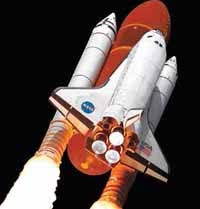
NASA managers will hold a news conference at 11 a.m. CST today at the agency's Johnson Space Center in Houston to discuss the next space shuttle mission, STS-133, and the progress of repairs since Discovery's original launch delay Nov. 5. The news conference follows Thursday's Space Shuttle Program Requirements Control Board meeting. Program officials reviewed repairs and engineering evaluations associated with cracks on two 21-foot-long, U-shaped aluminum brackets called stringers on the shuttle's external tank.
The briefing participants are:
-- Bill Gerstenmaier, associate administrator for Space Operations
-- John Shannon, Space Shuttle Program manager
-- Mike Suffredini, International Space Station Program manager
The news conference will air live on NASA Television and the agency's website. Reporters may ask questions from participating NASA centers or by calling into a phone bridge. To use the phone bridge, reporters must have valid media credentials issued by a NASA center or issued specifically for the STS-133 mission. Journalists planning to use the phone bridge must contact the Johnson newsroom at 281-483-5111 no later than 10:45 a.m. Newsroom personnel will verify credentials and transfer reporters to the phone bridge. Capacity is limited and available on a first-come, first-serve basis.

NASA managers will hold a news conference at 2 p.m. CST today from the agency's Johnson Space Center in Houston to provide the status of the next space shuttle mission, STS-133, and the progress of repairs since Discovery's launch was delayed Nov. 5. The news conference will follow today's Space Shuttle Program Requirements Control Board. Program officials reviewed repairs and engineering evaluations associated with cracks on two 21-foot-long, U-shaped aluminum brackets called stringers on the shuttle's external tank.
The briefing participants are:
-- Bill Gerstenmaier, associate administrator for Space Operations
-- John Shannon, Space Shuttle Program manager
The news conference will air live on NASA Television and the agency's website. Reporters may ask questions from participating NASA centers or by calling into a phone bridge. To use the phone bridge, reporters must have valid media credentials issued by a NASA center or issued specifically for the STS-133 mission. Journalists planning to use the phone bridge must contact the Johnson newsroom at 281-483-5111 no later than 15 minutes before the news conference. Newsroom personnel will verify credentials and transfer reporters to the phone bridge. Capacity is limited and available on a first-come, first-serve basis.
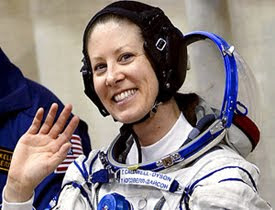
Recently returned from a six-month stay aboard the International Space Station, astronaut Tracy Caldwell Dyson will be available for live satellite interviews from NASA's Johnson Space Center in Houston between 8:15 a.m. and 10 a.m. CDT on Friday, Oct. 15. To arrange an interview, reporters should contact producer Jeremiah Maddix at 281-483-8631, 281-414-6995 or jeremiah.m.maddix@nasa.gov by 2 p.m., Thursday, Oct. 14. Video b-roll of Dyson’s flight will air Oct 15 from 7:45 a.m. to 8:15 a.m. on NASA Television.
Dyson and her crewmates launched aboard the Soyuz TMA-18 crew capsule from the Baikonur Cosmodrome in Kazakhstan in April. During the 174-day mission, Dyson served as a flight engineer for Expeditions 23 and 24 and conducted three spacewalks, logging 22 hours and 49 minutes outside the station. The crew replaced a faulty cooling pump module on the station’s backbone, known as the truss. The Expedition 24 crew landed safely in central Kazakhstan on Sept. 25. Dyson was born and raised in Arcadia, Calif. She earned a bachelor’s degree in chemistry from California State University at Fullerton and a doctorate in chemistry from the University of California at Davis.
Dyson flew as a mission specialist on the STS-118 space shuttle mission. On the flight, she operated Endeavor’s robotic arm and directed four spacewalks as the intravehicular crew member. NASA TV's Live Interview Media Outlet channel will be used for the interviews. The channel is a digital satellite C-band downlink by uplink provider Americom. It is on satellite AMC 3, transponder 9C, located at 87 degrees west, downlink frequency 3865.5 Mhz based on a standard C-band, horizontal downlink polarity. FEC is 3/4, data rate is 6.0 Mbps, symbol rate is 4.3404 Msps, transmission DVB-S, 4:2:0.

NASA is offering live satellite interviews on Thursday, Sept. 16, from inside the next component of the International Space Station. The Permanent Multipurpose Module, or PMM, will launch in November aboard space shuttle Discovery. Scott Higginbotham, payloads manager for Discovery’s STS-133 mission, will conduct the interviews from the Space Station Processing Facility at NASA's Kennedy Space Center in Florida. To maintain a pristine environment inside the PMM, Higginbotham will be dressed in protective blue clothing, known as a “bunny suit,” that prevents even the smallest dust particles from causing contamination. Interview slots are available from 6 - 9 a.m. EDT.
To schedule interviews, media should contact Alysia Lee at 321-861-3530 or alysia.k.lee@nasa.gov by noon on Wednesday, Sept. 15. The PMM will carry a variety of spare parts and supplies, as well as Robonaut 2, or R2, the first human-like robot in space. The PMM can support experiments in fluid physics, materials science, biology, biotechnology and other microgravity experiments. A prepackaged video of Higginbotham providing a tour of the PMM and video b-roll of the PMM's interior will air on NASA TV Sept. 16 from 5:30 - 6 a.m., and between interviews when possible. Higginbotham has worked for NASA since 1987, beginning his career in the Space Shuttle Program as a mechanical systems engineer for the external fuel tank.
He currently is a mission manager in the International Space Station and Spacecraft Processing Directorate responsible for leading teams of engineers and technicians that assemble and test experiments, satellites, and station components to fly aboard the shuttle. The NASA Television Live Interview Media Outlet channel will be used for the interviews. The channel is a digital satellite C-band downlink by uplink provider Americom. It is on satellite AMC 3, transponder 9C, located at 87 degrees west, downlink frequency 3865.5 Mhz based on a standard C-band, horizontal downlink polarity. FEC is 3/4, data rate is 6.0 Mbps, symbol rate is 4.3404 Msps, transmission DVB-S, 4:2:0.

The return to Earth of three International Space Station crew members and the prelaunch activities, launch and docking of the station’s newest trio of residents will be broadcast on NASA Television during the next several weeks. After almost six months aboard the orbital laboratory, Expedition 24 Soyuz Commander Alexander Skvortsov, NASA Flight Engineer Tracy Caldwell Dyson and Russian Flight Engineer Mikhail Kornienko are scheduled to land their Soyuz TMA-18 spacecraft in southern Kazakhstan on Sept. 23 (Sept. 24 in Kazakhstan). Russian cosmonaut and Soyuz Commander Alexander Kaleri, NASA Flight Engineer Scott Kelly and Russian Flight Engineer Oleg Skripochka will launch aboard the Soyuz TMA-01M on Oct. 7 (Oct. 8 in Kazakhstan) from the Baikonur Cosmodrome in Kazakhstan.
They will join NASA astronaut and Expedition 25 Commander Doug Wheelock, NASA Flight Engineer Shannon Walker and Russian cosmonaut Fyodor Yurchikhin, who have been aboard the station since June 18. The coverage begins with a NASA TV Video File feed at 11 a.m. CDT Sept. 17. The footage will include the prelaunch news conference with Kelly, Kaleri and Skripochka at the Gagarin Cosmonaut Training Center in Star City, Russia, and their ceremonial visit to lay flowers at the Kremlin Wall in Red Square in Moscow. A change of command ceremony in which Skvortsov will hand over command of the station to Wheelock will be conducted at 4:05 p.m. Sept. 22. It will be replayed during NASA TV’s International Space Station Update at 10 a.m. Sept. 23 and during landing coverage that evening.

Journalists are invited to cover space shuttle Discovery’s last move from the Vehicle Assembly Building (VAB) to Launch Pad 39A on Sept. 20 at NASA’s Kennedy Space Center in Florida. Six astronauts are set to launch aboard the shuttle on Nov. 1. The STS-133 mission to the International Space Station is the final scheduled flight for Discovery before it is retired. Live coverage of Discovery's rollout will air on NASA Television beginning at 8 p.m. EDT. NASA TV’s Video File will broadcast highlights of the move. Discovery's first motion out of the VAB to the pad is scheduled for 8 p.m. The shuttle's 3.4- mile journey atop a giant crawler-transporter is expected to take approximately six hours. Activities include an 8 p.m. photo opportunity of the move followed by an interview availability at 8:30 p.m. with Discovery Flow Director Stephanie Stilson. Media must arrive at Kennedy's news center by 7:30 p.m. for the rollout photo opportunity.
There also will be a sunrise photo opportunity at the launch pad on Sept. 21, following Discovery’s arrival. Reporters need to be at the news center for transportation to the viewing area by 6 a.m. Updates for events are available at 321-867-2525. To attend rollout and the sunrise pad photo opportunity, international journalists must apply by 5 p.m. Sept. 13 to allow time for processing their requests. U.S. media representatives must apply by Sept. 17. Badges for rollout may be picked up starting at 6 a.m., Sept. 20, at the Kennedy Space Center Badging Office on State Road 405. The 11-day mission will be the 35th flight to the station and the 39th flight for Discovery. The mission will deliver and install the Permanent Multipurpose Module, the Express Logistics Carrier 4 - an external platform that holds large equipment - and critical spare components for the space station. Discovery also will deliver Robonaut 2, or R2, to become a permanent resident of the station as the first human-like robot in space.

A NASA team sent to Chile to aid trapped miners will hold a news conference about their work at the San Jose gold and copper mine near Copiapo at noon CDT, Tuesday, Sept. 7. The conference will be at NASA's Johnson Space Center in Houston, and it will air live on NASA Television and the agency's website. The participants also will answer questions from reporters at participating NASA centers. For journalists not able to attend at a NASA center, a limited number of phone lines are available by calling 281-483-5111 by 11:45 a.m. on Tuesday. U.S. news media planning to attend the briefing in person must contact the Johnson newsroom at 281-483-5111 by 10 a.m. Tuesday. Reporters interested in a one-on-one interview must contact the Johnson newsroom by 11:30 a.m. Tuesday.
NASA responded to a request from the government of Chile, submitted through the U.S. Department of State, to provide technical advice that might assist the trapped miners. The NASA team of two medical doctors, a psychologist and an engineer arrived in Chile Aug. 31. Dr. Michael Duncan, deputy chief medical officer in the Space Life Sciences Directorate at Johnson, led the team. The other members are physician James Polk and psychologist Albert Holland from Johnson; and Clint Cragg, principal engineer with the NASA Engineering and Safety Center located at NASA's Langley Research Center in Hampton, Va. The team will participate in the news conference. Afterward, Duncan will be available for one-on-one interviews.
 The next crew to live and work on the International Space Station will participate in a news conference at 1 p.m. CDT on Wednesday, Sept. 15, at NASA's Johnson Space Center in Houston. The news conference will air live on NASA Television and the agency's website. The crew also will answer questions from reporters at participating NASA centers and from those in Europe. NASA astronaut Cady Coleman and her crewmates Dmitry Kondratiev, of the Russian Space Agency, and Paolo Nespoli, of the European Space Agency, will participate in individual round-robin interviews, in person or by phone, following the news conference. The crew also will participate in a photo opportunity for reporters at Johnson.
U.S. and foreign media representatives planning to attend the briefing must contact the Johnson newsroom at 281-483-5111 by 4 p.m. on Tuesday, Sept. 7. To participate in the round-robin interviews, reporters should contact the Johnson newsroom by 4 p.m. on Tuesday, Sept. 13. Coleman, Kondratiev and Nespoli will constitute three of the six crewmembers for both Expedition 26 and 27. They will launch aboard a Russian Soyuz spacecraft from the Baikonur Cosmodrome in Kazakhstan in mid-December. They will join NASA's Scott Kelly, who will command the station, and Flight Engineers Alexander Kaleri and Oleg Skripochka. Kelly, Kaleri and Skripochka will launch in a separate Soyuz on Oct. 7 and arrive at the orbiting laboratory Oct. 9.
The next crew to live and work on the International Space Station will participate in a news conference at 1 p.m. CDT on Wednesday, Sept. 15, at NASA's Johnson Space Center in Houston. The news conference will air live on NASA Television and the agency's website. The crew also will answer questions from reporters at participating NASA centers and from those in Europe. NASA astronaut Cady Coleman and her crewmates Dmitry Kondratiev, of the Russian Space Agency, and Paolo Nespoli, of the European Space Agency, will participate in individual round-robin interviews, in person or by phone, following the news conference. The crew also will participate in a photo opportunity for reporters at Johnson.
U.S. and foreign media representatives planning to attend the briefing must contact the Johnson newsroom at 281-483-5111 by 4 p.m. on Tuesday, Sept. 7. To participate in the round-robin interviews, reporters should contact the Johnson newsroom by 4 p.m. on Tuesday, Sept. 13. Coleman, Kondratiev and Nespoli will constitute three of the six crewmembers for both Expedition 26 and 27. They will launch aboard a Russian Soyuz spacecraft from the Baikonur Cosmodrome in Kazakhstan in mid-December. They will join NASA's Scott Kelly, who will command the station, and Flight Engineers Alexander Kaleri and Oleg Skripochka. Kelly, Kaleri and Skripochka will launch in a separate Soyuz on Oct. 7 and arrive at the orbiting laboratory Oct. 9.
Interview footage of two NASA astronauts scheduled next year to become the first twins to rendezvous in space is available on NASA Television and the agency's website. Mark Kelly will command the last scheduled space shuttle flight, while his twin brother Scott Kelly will be in command of the International Space Station. During the interview, they discuss growing up in West Orange, N.J., their paths to becoming astronauts, and the possibilities of a joint mission in space. The Kellys, both captains in the U.S. Navy, were born Feb. 21, 1964, in Orange, N.J. Scott has flown on two prior shuttle missions, as pilot of STS-103 in 1999 and commander of STS-118 in 2007. Mark is a veteran of three prior shuttle missions, as pilot of STS-108 in 2001 and STS-121 in 2006, and commander of STS-124 in 2008.
Scott is scheduled to launch to the space station aboard a Russian Soyuz spacecraft from the Baikonur Cosmodrome in Kazakhstan on Oct. 7 for a six-month-long mission aboard the complex. He will serve as flight engineer for Expedition 25 and commander for Expedition 26. Mark, commander of shuttle Endeavour's STS-134 mission, is scheduled to visit the station in February to deliver supplies and the Alpha Magnetic Spectrometer. The device will study the universe's origin by searching for antimatter, dark matter, and strange matter, and by measuring cosmic rays. If the launch schedule doesn't change, the pair would be working together in orbit for eight days before the shuttle undocks and returns to Earth.
 In early August 2005, Katrina was just a name. By September, it had become synonymous with the costliest and one of the deadliest tropical cyclones in U.S. history. Five years later, NASA is revisiting Hurricane Katrina with a short video that shows the storm as captured by NASA satellites. NASA provides space-based satellite observations, field research missions, and computer climate modeling to further scientists' understanding of these storms. NASA also provides measurements and modeling of global sea surface temperatures, precipitation, winds and ocean heat content all ingredients that contribute to the formation of tropical cyclones.
On Aug. 29, 2005, after passing over the Caribbean and Florida, Katrina made landfall along the Gulf Coast as a category 3 hurricane on the Saffir-Simpson scale. As hurricanes go, Katrina was actually only moderate in size when it reached the Mississippi and Louisiana coasts, having weakened from a category 5 the day before. However, Katrina had a very wide footprint, which caused a broad area of large ocean swells to develop within the Gulf of Mexico. As the hurricane made its final landfall, the resulting storm surge was massive and unrelenting. Ultimately, this storm surge was responsible for much of the damage as it flooded coastal communities, overwhelmed levees, and left at least 80 percent of New Orleans underwater.
By the time the hurricane subsided, Katrina had claimed more than 1,800 human lives and caused roughly $125 billion in damages. As scientists and rescue organizations worked on the ground to prepare for the hurricane and assist in its wake, NASA provided data gathered from a series of Earth-observing satellites to help predict the hurricane's path and intensity. In the aftermath, NASA satellites also helped identify areas hardest hit. In this 3 1/2-minute video created by NASA-TV producer Jennifer Shoemaker at NASA's Goddard Space Flight Center in Greenbelt, Md., viewers will see many different kinds of data NASA satellites gathered about the storm. The video contains a sampling of the kinds of things NASA studies about hurricanes. Various additional data products are created in hurricane and post-hurricane research that are not depicted in the video.
In early August 2005, Katrina was just a name. By September, it had become synonymous with the costliest and one of the deadliest tropical cyclones in U.S. history. Five years later, NASA is revisiting Hurricane Katrina with a short video that shows the storm as captured by NASA satellites. NASA provides space-based satellite observations, field research missions, and computer climate modeling to further scientists' understanding of these storms. NASA also provides measurements and modeling of global sea surface temperatures, precipitation, winds and ocean heat content all ingredients that contribute to the formation of tropical cyclones.
On Aug. 29, 2005, after passing over the Caribbean and Florida, Katrina made landfall along the Gulf Coast as a category 3 hurricane on the Saffir-Simpson scale. As hurricanes go, Katrina was actually only moderate in size when it reached the Mississippi and Louisiana coasts, having weakened from a category 5 the day before. However, Katrina had a very wide footprint, which caused a broad area of large ocean swells to develop within the Gulf of Mexico. As the hurricane made its final landfall, the resulting storm surge was massive and unrelenting. Ultimately, this storm surge was responsible for much of the damage as it flooded coastal communities, overwhelmed levees, and left at least 80 percent of New Orleans underwater.
By the time the hurricane subsided, Katrina had claimed more than 1,800 human lives and caused roughly $125 billion in damages. As scientists and rescue organizations worked on the ground to prepare for the hurricane and assist in its wake, NASA provided data gathered from a series of Earth-observing satellites to help predict the hurricane's path and intensity. In the aftermath, NASA satellites also helped identify areas hardest hit. In this 3 1/2-minute video created by NASA-TV producer Jennifer Shoemaker at NASA's Goddard Space Flight Center in Greenbelt, Md., viewers will see many different kinds of data NASA satellites gathered about the storm. The video contains a sampling of the kinds of things NASA studies about hurricanes. Various additional data products are created in hurricane and post-hurricane research that are not depicted in the video.

NASA and Alliant Techsystems Inc. (ATK) will conduct a full-scale test of a five-segment, first-stage solid rocket motor at 11:05 a.m. EDT, Tuesday, Aug. 31. The test at the ATK Aerospace Systems test facility in Promontory, Utah will assess motor performance at low temperatures. The static firing of the solid motor, designated Development Motor-2, will last two minutes. This is the most heavily instrumented solid rocket motor in NASA history, with 53 test objectives that will be measured using more than 760 instruments. The motor was built as an element of NASA's Constellation Program.
It is the largest and most powerful solid rocket motor designed for flight and is highly transferable to future heavy-lift vehicle designs. To attend the test, U.S. journalists must register with ATK by Aug. 27. For information and to request credentials, contact ATK's Trina Patterson at 801-699-0943. NASA Television's live coverage of the test will begin at 11 a.m. and will broadcast a news conference at 12 p.m. with representatives from NASA and ATK. To participate by teleconference, reporters should e-mail Michael Braukus, michael.j.braukus@nasa.gov for dial-in information.
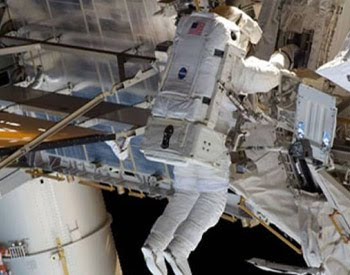
The third spacewalk to restore full cooling capability to the International Space Station is scheduled for Monday, Aug. 16. Expedition 24 Flight Engineers Doug Wheelock and Tracy Caldwell Dyson will venture outside to install a replacement pump and connect its electrical and fluid lines. The two NASA astronauts conducted the first two spacewalks to remove the failed ammonia pump from the station's truss, or backbone. The pump removed during Wednesday's spacewalk failed on July 31, causing a loss of half of the station's cooling system. Since then, the station has been operating normally while a second ammonia pump provides cooling for electronics.
NASA Television coverage will begin Monday at 5 a.m. CDT. Wheelock and Caldwell Dyson are scheduled to begin the spacewalk just before 6 a.m. Monday's spacewalk will be the sixth for Wheelock and the third for Caldwell Dyson. Approximately two hours after the conclusion of the spacewalk, NASA TV will broadcast a briefing from NASA's Johnson Space Center in Houston. The briefing participants will be Kirk Shireman, International Space Station deputy program manager; Courtenay McMillan, Expedition 24 spacewalk flight director; and David Beaver, Expedition 24 spacewalk officer.
Reporters may ask questions from participating NASA locations, and should contact their preferred NASA center to confirm participation. Johnson's newsroom will be open for credentialed reporters to attend the briefing. Johnson also will operate a telephone bridge for reporters with valid media credentials issued by a NASA center. Journalists planning to use the service must contact the Johnson newsroom at 281-483-5111 no later than 15 minutes prior to the start of the briefing. Phone bridge capacity is limited and will be available on a first-come, first-served basis.

For the first time, twin brothers are slated to be in space simultaneously early next year. Mark Kelly will be in command of the last scheduled space shuttle flight, and Scott Kelly in command of the International Space Station. The Kelly brothers will be available for live satellite interviews between 9:15 and 11:15 a.m. CDT Tuesday, Aug. 17. Scott Kelly is scheduled to launch to the space station aboard a Russian Soyuz spacecraft from the Baikonur Cosmodrome in Kazakhstan on Oct. 7 (Oct. 8 local time) for a six-month-long mission aboard the complex. He will serve as flight engineer for Expedition 25 and commander for Expedition 26.
His twin brother Mark, commander of shuttle Endeavour's STS-134 mission, is scheduled to visit the station in February to deliver supplies and the Alpha Magnetic Spectrometer. AMS is a device to study the universe's origin by searching for antimatter, dark matter, strange matter and measuring cosmic rays. If the launch schedule holds, the pair would be working together in orbit for eight days before the shuttle undocks and returns to Earth. To arrange an interview, reporters should contact producer Jeremiah Maddix at 281-483-8631 or by e-mail to jeremiah.m.maddix@nasa.gov by 5 p.m. Monday, Aug. 16. Video b-roll of the Kellys' previous missions and training will air on NASA TV Aug. 17 from 8:45 to 9:15 a.m.
The Kellys, both captains in the U.S. Navy, were born Feb. 21, 1964, in Orange, N.J., and consider West Orange, N.J., their hometown. Scott has flown on two prior shuttle missions: as pilot of STS-103 in 1999 and as commander of STS-118 in 2007. Mark is a veteran of three prior shuttle missions: as pilot of STS-108 in 2001 and STS-121 in 2006, and as commander of STS-124 in 2008. The NASA Television Live Interview Media Outlet channel will be used for the interviews. The channel is a digital satellite C-band downlink by uplink provider Americom. It is on satellite AMC 3, transponder 9C, located at 87 degrees west, downlink frequency 3865.5 Mhz based on a standard C-band, horizontal downlink polarity. FEC is 3/4, data rate is 6.0 Mbps, symbol rate is 4.3404 Msps, transmission DVB-S, 4:2:0.

The first of two spacewalks by NASA astronauts to replace a failed ammonia pump on the International Space Station has been moved to Saturday, Aug. 7. A second spacewalk is planned for Wednesday, Aug. 11, to complete the repairs. Teams of flight controllers, engineers, and spacewalk experts have made significant progress in preparing for the first spacewalk, but need an additional day to get ready. The additional time allows for final procedures to be sent late Thursday to the station, giving the crew a full day to review the plans developed by Mission Control. Managers also moved the second spacewalk to Wednesday to give the crew more time to rest and prepare.
Expedition 24 Flight Engineers Doug Wheelock and Tracy Caldwell Dyson are scheduled to perform the spacewalks, which will air on NASA Television. Coverage will begin at 5 a.m. CDT. The spacewalks are scheduled to begin at 5:55 a.m. Saturday's spacewalk will be the fourth for Wheelock and the first for Caldwell Dyson. Approximately two hours after the conclusion of each spacewalk, NASA TV will broadcast a briefing from NASA's Johnson Space Center. The briefing participants will be Mike Suffredini, International Space Station program manager; Courtenay McMillan, Expedition 24 spacewalk flight director; and David Beaver, Expedition 24 spacewalk officer. Johnson's newsroom will be open for credentialed reporters to attend the briefing.
Johnson also will operate a telephone bridge for reporters with valid media credentials issued by a NASA center. Journalists planning to use the service must contact the Johnson newsroom at 281-483-5111 no later than 15 minutes prior to the start of a briefing. Phone bridge capacity is limited and will be available on a first-come, first-served basis. Engineers and flight controllers continue to review data on the July 31 pump failure, which caused the loss of one of two cooling loops aboard the station. This failure resulted in a power down and required adjustments to maintain as much redundancy as possible for the station systems. The systems are stable, and the station's six crew members are not in any danger.

The first of two spacewalks by NASA astronauts to replace a failed ammonia pump on the International Space Station has been delayed by 24 hours to Friday, Aug. 6. A second spacewalk is planned for Monday, Aug. 9, to complete the repairs. Flight controllers and station managers made the decision Monday night after reviewing proposed timelines, final procedures for the repair work, and the results from a spacewalk dress rehearsal conducted in the Neutral Buoyancy Laboratory near NASA's Johnson Space Center in Houston. Expedition 24 Flight Engineers Doug Wheelock and Tracy Caldwell Dyson are scheduled to perform the spacewalks.
The two NASA astronauts will replace an ammonia coolant pump that failed July 31. NASA Television coverage of both spacewalks will begin at 5 a.m. CDT. Wheelock and Caldwell Dyson are expected to begin the spacewalks from the Quest airlock at 5:55 a.m. Friday's spacewalk will be the fourth for Wheelock and Caldwell Dyson's first. Approximately two hours after the conclusion of each spacewalk, NASA TV will broadcast a briefing from Johnson. The briefing participants will be Mike Suffredini, International Space Station program manager; Courtenay McMillan, Expedition 24 spacewalk flight director; and David Beaver, Expedition 24 spacewalk officer.
Reporters may ask questions from participating NASA locations, and should contact their preferred NASA center to confirm participation. Johnson will operate a telephone bridge for reporters with valid media credentials issued by a NASA center. Journalists planning to use the service must contact the Johnson newsroom at 281-483-5111 no later than 15 minutes prior to the start of a briefing. Phone bridge capacity is limited and will be available on a first-come, first-serve basis. Engineers and flight controllers continue to review data on the failure, which resulted in the loss of one of two cooling loops aboard the station.

NASA managers will discuss updated plans for two International Space Station spacewalks during a news briefing at 3 p.m. CDT on Monday, Aug. 2. The briefing replaces one originally scheduled for Tuesday.The news conference from NASA's Johnson Space Center in Houston will air live on NASA Television and the agency's website. Journalists may ask questions from participating NASA locations.
The briefers are:
- Michael Suffredini, manager, International Space Station Program
- Courtenay McMillan, Expedition 24 spacewalk flight director
Expedition 24 Flight Engineers Doug Wheelock and Tracy Caldwell Dyson are scheduled to perform two spacewalks. The two NASA astronauts will replace an ammonia coolant pump that failed July 31. Engineers and flight controllers continue to review data on the failure, which resulted in the loss of one of two cooling loops aboard the station. This caused a significant power down and required adjustments to provide the maximum redundancy possible for station systems. The systems are stable, and the six crew members aboard are not in any danger.
Wheelock and Caldwell Dyson originally were scheduled to perform a spacewalk to outfit the Russian Zarya module for future robotics work and prepare the station for the installation of a new U.S. permanent multipurpose module. However, because of the importance of restoring redundancy to the station's cooling and power systems, Thursday's spacewalk will be dedicated to the pump module replacement. Another spacewalk will be scheduled a few days later to complete the repairs. NASA TV coverage of the 15th U.S. spacewalk from the station will begin at 5 a.m. on Thursday, Aug. 5. Wheelock and Caldwell Dyson are expected to begin the spacewalk from the Quest airlock at 5:55 a.m. It will be Wheelock's fourth spacewalk and Caldwell Dyson's first.
 NASA managers have set the liftoff of space shuttle Endeavour for 8:56 a.m. EDT on Monday, May 16. Launch attempts are available through May 26, except for May 21. The STS-134 mission to the International Space Station is the penultimate shuttle flight and the final one for Endeavour. Space Shuttle Program Launch Integration Manager Mike Moses and Shuttle Launch Director Mike Leinbach announced the date at a news briefing Monday from NASA's Kennedy Space Center in Florida. They also discussed the progress of repairs since Endeavour's launch postponement on April 29.


