
NASA's Mars Science Laboratory rover, Curiosity, will carry a next generation, onboard "chemical element reader" to measure the chemical ingredients in Martian rocks and soil. The instrument is one of 10 that will help the rover in its upcoming mission to determine the past and present habitability of a specific area on the Red Planet. Launch is scheduled between Nov. 25 and Dec. 18, 2011, with landing in August 2012. The Alpha Particle X-Ray Spectrometer (APXS) instrument, designed by physics professor Ralf Gellert of the University of Guelph in Ontario, Canada, uses the power of alpha particles, or helium nuclei, and X-rays to bombard a target, causing the target to give off its own characteristic alpha particles and X-ray radiation. This radiation is "read by" an X-ray detector inside the sensor head, which reveals which elements and how much of each are in the rock or soil.
Identifying the elemental composition of lighter elements such as sodium, magnesium or aluminum, as well as heavier elements like iron, nickel or zinc, will help scientists identify the building blocks of the Martian crust. By comparing these findings with those of previous Mars rover findings, scientists can determine if any weathering has taken place since the rock formed ages ago. All NASA Mars rovers have carried a similar instrument Pathfinder's rover Sojourner, Spirit and Opportunity, and now Curiosity, too. Improvements have been made with each generation, but the basic design of the instrument has remained the same.
"APXS was modified for Mars Science Laboratory to be faster so it could make quicker measurements. On the Mars Exploration Rovers it took us five to 10 hours to get information that we will now collect in two to three hours," said Gellert, the intrument's principal investigator. “We hope this will help us to investigate more samples.” Another significant change to the next-generation APXS is the cooling system on the X-ray detector chip. The instruments used on Spirit and Opportunity were able to take measurements only at night. But the new cooling system will allow the instrument on Curiosity to take measurements during the day, too.

NASA's next rover will blast Martian rocks with a rock-zapping laser tool. The Chemistry and Camera tool on the rover Curiosity can excite a pinhead-size mark into a glowing, ionized gas. It then watch the flash through a telescope and analyze the range of light to recognize the chemical elements in the target. The data about rocks or patches will help the team review the rover's surroundings and choose which target to drill into, or scoop up. With this data, they can decide if any environment in the land area have been favorable for microbial life and for preserving proof about whether life existed.
In late 2011, NASA will open Curiosity and the other part of the flight system, deliver the rover to the outside of Mars in August 2012, information the Science Daily. Roger Wiens, a geochemist with the U.S. Department of Energy's Los Alamos National Laboratory, future the instrument during NASA's 2004 open competition for contribution in the Mars Science Laboratory project. The idea strike when he visit a chemistry laboratory building where a colleague, Dave Cremers, who had been trial with a dissimilar laser technique. "The room was sound used. Every flat surface was enclosed with instruments, lenses or visual mounts. The filing cabinet look like they had a bad case of acne. I found out afterward that they were used for laser aim practice," said Wiens.
From that point, after 10 years of international growth and testing, the project resulted in ChemCam being installed on Curiosity in September 2010. "The trick is very small bursts of the laser. You actually dump a lot of energy onto a small spot-megawatts per square millimeter-but just for a little nanoseconds," Wiens said. The flash comes back to ChemCam through the instrument telescope, mount beside the laser tall on the rover's camera mast. The telescope direct the light down an optical fiber to three spectrometers within the rover. The spectrometers evidence intensity at 6,144 different wavelengths of ultraviolet, noticeable and infrared light.
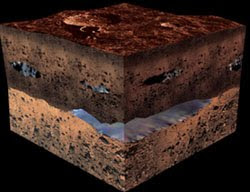
The ground where NASA's Mars Exploration Rover Spirit became stuck last year holds evidence that water, perhaps as snow melt, trickled into the subsurface fairly recently and on a continuing basis. Stratified soil layers with different compositions close to the surface led the rover science team to propose that thin films of water may have entered the ground from frost or snow. The seepage could have happened during cyclical climate changes during periods when Mars tilted farther on its axis. The water may have moved down into the sand, carrying soluble minerals deeper than less-soluble ones. Spin-axis tilt varies over timescales of hundreds of thousands of years. The relatively insoluble minerals near the surface include what is thought to be hematite, silica and gypsum.
Ferric sulfates, which are more soluble, appear to have been dissolved and carried down by water. None of these minerals is exposed at the surface, which is covered by wind-blown sand and dust. "The lack of exposures at the surface indicates the preferential dissolution of ferric sulfates must be a relatively recent and ongoing process since wind has been systematically stripping soil and altering landscapes in the region Spirit has been examining," said Ray Arvidson of Washington University in St. Louis, deputy principal investigator for the twin rovers Spirit and Opportunity. Analysis of these findings appears in a report in the Journal of Geophysical Research published by Arvidson and 36 co-authors about Spirit's operations from late 2007 until just before the rover stopped communicating in March.
The twin Mars rovers finished their three-month prime missions in April 2004, then kept exploring in bonus missions. One of Spirit's six wheels quit working in 2006. In April 2009, Spirit's left wheels broke through a crust at a site called "Troy" and churned into soft sand. A second wheel stopped working seven months later. Spirit could not obtain a position slanting its solar panels toward the sun for the winter, as it had for previous winters. Engineers anticipated it would enter a low-power, silent hibernation mode, and the rover stopped communicating March 22. Spring begins next month at Spirit's site, and NASA is using the Deep Space Network and the Mars Odyssey orbiter to listen if the rover reawakens. Researchers took advantage of Spirit's months at Troy last year to examine in great detail soil layers the wheels had exposed, and also neighboring surfaces.

Community college students in a pilot program will take the first steps toward potential technology careers as they develop robotic explorers at NASA field centers. Ninety students from community colleges in 23 states have been selected to travel to NASA's Johnson Space Flight in Houston or the Marshall Space Flight Center in Huntsville, Ala., for hands on experience with technology development and direct interaction with NASA experts. This week, the White House Summit on Community Colleges explored how these institutions can support a highly educated and skilled workforce. Concurrently, NASA is preparing for the culmination of the National Community College Aerospace Scholars pilot program.
The agency will bring young scholars to join agency professionals Oct. 20-22 to develop rovers to explore the surfaces of other worlds and learn more about actual careers in science and engineering. During the summer, students enrolled in the program completed four Web-based assignments that explored topics in engineering and technology. Those whose grades on the projects averaged at least 94 percent qualified to participate in the NASA field center experience, with the agency paying students' travel expenses. Students will apply what they have learned during the year to technology and design problems in consultation with NASA engineers.
"Community colleges are an important part of the academic landscape, and NASA is proud to be working with these students to continue their interest and skills in science, technology, engineering and mathematics," said NASA Administrator Charles Bolden. "This innovative project gets students engaged in actual engineering design and production from concept to build-out that simulates the processes NASA uses in designing robotic explorers for solar system destinations. By letting them experience first-hand the challenges and excitement inherent in space exploration, we may be cultivating NASA's workforce of tomorrow."

Images that NASA's Mars Exploration Rover Opportunity took at the end of an 81-meter (266-foot) drive on Sept. 16 reveal a dark rock about 31 meters (102 feet) away. The rover's science team has decided to go get a closer look at the toaster-sized rock and determine whether it is an iron meteorite. "The dark color, rounded texture and the way it is perched on the surface all make it look like an iron meteorite," said science-team member Matt Golombek of NASA's Jet Propulsion Laboratory, Pasadena, Calif. Opportunity has found four iron meteorites during the rover's exploration of the Meridiani Planum region of Mars since early 2004. Examination of these rocks has provided information about the Martian atmosphere, as well as the meteorites themselves.
The newfound rock has been given the informal name "Oileán Ruaidh" (pronounced ay-lan ruah), which is the Gaelic name for an island off the coast of northwestern Ireland. The rock is about 45 centimeters (18 inches) wide from the angle at which it was first seen. Opportunity has driven 23.3 kilometers (14.5 miles) on Mars. The drive to this rock will take the total combined distance driven by Opportunity and its twin, Spirit, to more than 31 kilometers (19.26 miles). JPL, a division of the California Institute of Technology in Pasadena, manages the Mars Exploration Rover mission for the NASA Science Mission Directorate, Washington. Opportunity landed on Mars in January 2004 for what was planned as a three-month mission.


