Showing posts with label sun. Show all posts

NASA Scientists Found Ice On Mercury


Mercury may be a boiling hunk of rock just next door to the hot sun, but planetary scientists have exposed nearly pure frozen water and even some natural material in the planet's frigid Polar Regions.The findings as of the Messenger spacecraft orbiting the planet cap the decades long look for for water on the second-hottest planet in the solar system and may assist scientists better appreciate the origins of the molecular structure blocks for life on Earth.

Before the Messenger spacecraft dropped into track in March 2011, Mercury remained incredible of an enigma. The Arecibo radio get smaller in Puerto Rico detected bright, shiny spot on the planet's surface in 1991, which scientists interpret as a strong sign of ice-covered water. These spots appear to map well with some of the indistinct parts of polar craters that were glimpsed in the 1970s by the Mariner 10 spacecraft, which saying only about partially of the planet's surface.

The Sun's Solar Cycle-Cosmic Rays On Earth


cosmic rays

A new learns of ice core samples have established the link between sunspot action and the Sun's solar cycle activity isn't as physically powerful as previously idea. Researchers have originate the Sun's 11 year solar cycle sustained normally during the Maunder least amount between 1645 and 1715, when sunspot activity was unusually low. This was also a time when northern Europe experienced unusually cold situation. Creased solar system wind activity as the Sun moves towards solar max, reduces the quantity of cosmic rays attainment Earth.

Solar Movement Rising On the Sun 2012

Solar Movement Rising On the Sun

A lot is person said about what is occurrence after a large coronal mass ejection, or CME, darned from the Sun a few days rear. It was on 2012 November 23 that the huge eruption happened on the Sun, and since then speculations are leaving on about the kind of behavior happening on the surface.

It was established after the Solar and Heliospheric Observatory (SOHO), manage to capture the CME moment. It was told such type of picture, known as a corona graph; reflect how the brightest light from the sun is barren from direct view. To explain it further, it have been claimed that CME involves distribution solar particle into space and then, reaching Earth 1 to 3 days later. It has also been claimed that this is the 3rd such Earth-directed CME as November 20th.

The Solar Fried Planets Atmosphere

Fried Planets


An international team of astronomers has fixed a star in the work of devouring one of its planets. BD+48 740, a red giant they pragmatic using the 9.2-meter Hobby-Eberly Telescope at the McDonald Observatory in Texas, appears to have the gas of a scorched planet in its atmosphere.  This is reliable with a rocky world, recently destroyed.
The great researchers who concentrate in stellar evolution have lengthy known that the inner planets are in danger.  The trouble starts in the isolated future when the sun's core runs out of hydrogen fuel for nuclear fusion. To keep the fires flaming, the sun will begin to fuse hydrogen external the core, in a layer closer to the stellar surface. This will turn the sun into a red oversize, at least 200 times wider than it is today. Mercury, Venus, Earth and possibly even Mars might be engulfed. 

The fate of Earth is not a confidence, however. Some researchers believe that Earth's orbit might spiral outward, keeping the planet at a safe space from the future inferno.  This could happen if solar winds carry a path a major fraction of the sun's mass in the years most important up to the red giant phase. On the other hand, the sun might get bigger so fast that our planet has no chance to escape.  Earth would get trapped in the sun's rapidly advancing atmosphere and spiral innermost to oblivion.

The Voyager spacecraft-100 Year Star-ship


The Voyager spacecraft, exposed in this artist's description barreling away from the sun, would take tens of thousands of years to attain the nearest star to Earth. Scientists and researchers with 100 Year Star-ship are probing faster space travel and other elements needed to send a human crew past the Solar System.

Although NASA has ended its space take program and the latest mission beyond our planet occupied a robotic Mars rover, rather than astronauts, a group of scientists and dreamers is working out how to send humans to the remote stars.

The plan, called 100 Year Star-ship, has original funding from the U.S. Defense Advanced Research Projects Agency (DARPA). It's snooping what would be required to take a ship and crew away from our solar system within the next century.

NASA's Swift And Hubble Probe Asteroid Collision Debris

http://nasa-satellites.blogspot.com/
Late last year, astronomers noticed an asteroid named Scheila had unexpectedly brightened, and it was sporting short-lived plumes. Data from NASA's Swift satellite and Hubble Space Telescope showed these changes likely occurred after Scheila was struck by a much smaller asteroid. "Collisions between asteroids create rock fragments, from fine dust to huge boulders, that impact planets and their moons," said Dennis Bodewits, an astronomer at the University of Maryland in College Park and lead author of the Swift study. "Yet this is the first time we've been able to catch one just weeks after the smash-up, long before the evidence fades away."

Asteroids are rocky fragments thought to be debris from the formation and evolution of the solar system approximately 4.6 billion years ago. Millions of them orbit the sun between Mars and Jupiter in the main asteroid belt. Scheila is approximately 70 miles across and orbits the sun every five years. "The Hubble data are most simply explained by the impact, at 11,000 mph, of a previously unknown asteroid about 100 feet in diameter," said Hubble team leader David Jewitt at the University of California in Los Angeles. Hubble did not see any discrete collision fragments, unlike its 2009 observations of P/2010 A2, the first identified asteroid collision.

The studies will appear in the May 20 edition of The Astrophysical Journal Letters and are available online. Astronomers have known for decades that comets contain icy material that erupts when warmed by the sun. They regarded asteroids as inactive rocks whose destinies, surfaces, shapes and sizes were determined by mutual impacts. However, this simple picture has grown more complex over the past few years. During certain parts of their orbits, some objects, once categorized as asteroids, clearly develop comet-like features that can last for many months. Others display much shorter outbursts. Icy materials may be exposed occasionally, either by internal geological processes or by an external one, such as an impact.

Global Eruption Rocks the Sun

http://nasa-satellites.blogspot.com/
On August 1, 2010, an entire hemisphere of the sun erupted. Filaments of magnetism snapped and exploded, shock waves raced across the stellar surface, billion-ton clouds of hot gas billowed into space. Astronomers knew they had witnessed something big. It was so big, it may have shattered old ideas about solar activity. "The August 1st event really opened our eyes," says Karel Schrijver of Lockheed Martin’s Solar and Astrophysics Lab in Palo Alto, CA. "We see that solar storms can be global events, playing out on scales we scarcely imagined before." For the past three months, Schrijver has been working with fellow Lockheed-Martin solar physicist Alan Title to understand what happened during the "Great Eruption."

They had plenty of data: The event was recorded in unprecedented detail by NASA's Solar Dynamics Observatory and twin STEREO spacecraft. With several colleagues present to offer commentary, they outlined their findings at a press conference today at the American Geophysical Union meeting in San Francisco. Explosions on the sun are not localized or isolated events, they announced. Instead, solar activity is interconnected by magnetism over breathtaking distances. Solar flares, tsunamis, coronal mass ejections--they can go off all at once, hundreds of thousands of miles apart, in a dizzyingly-complex concert of violence.

"To predict eruptions we can no longer focus on the magnetic fields of isolated active regions," says Title, "we have to know the surface magnetic field of practically the entire sun." This revelation increases the work load for space weather forecasters, but it also increases the potential accuracy of their forecasts. "The whole-sun approach could lead to breakthroughs in predicting solar activity," commented Rodney Viereck of NOAA's Space Weather Prediction Center in Boulder, CO. "This in turn would provide improved forecasts to our customers such as electric power grid operators and commercial airlines, who could take action to protect their systems and ensure the safety of passengers and crew."

NASA Funded Study Shows Desert Dust Cuts Colorado River Flow

http://nasa-satellites.blogspot.com/
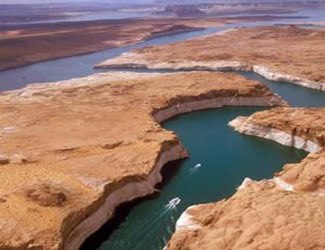
Snow melt in the Colorado River basin is occurring earlier, reducing runoff and the amount of crucial water available downstream. A new study shows this is due to increased dust caused by human activities in the region during the past 150 years. The study, led by a NASA scientist and funded by the agency and the National Science Foundation (NSF), showed peak spring runoff now comes three weeks earlier than before the region was settled and soils were disturbed. Annual runoff is lower by more than five percent on average compared to pre-settlement levels.

The findings have major implications for the 27 million people in the seven U.S. states and Mexico who rely on the Colorado River for drinking, agricultural and industrial water. The results were published in this week's Proceedings of the National Academy of Sciences. The research team was led by Tom Painter, a snow hydrologist at both NASA's Jet Propulsion Laboratory in Pasadena, Calif., and the University of California at Los Angeles. The team examined the impact of human-produced dust deposits on mountain snowpacks over the Upper Colorado River basin between 1915 and 2003. Studies of lake sediment cores showed the amount of dust falling in the Rocky Mountains increased by 500 to 600 percent since the mid-to-late 1800s when grazing and agriculture began to disturb fragile but stable desert soils.

The team used an advanced hydrology model to simulate the balance of water flowing into and out of the river basin under current dusty conditions and those that existed before soil was disturbed. Hydrologic data gathered from field studies funded by NASA and NSF and measurements of the absorption of sunlight by dust in snow were combined with the modeling. More than 80 percent of sunlight falling on fresh snow is typically reflected back into space. In the semi-arid regions of the Colorado Plateau and Great Basin, winds blow desert dust east, triggering dust-on-snow events. When dark dust particles fall on snow, they reduce its ability to reflect sunlight. The snow also absorbs more of the sun's energy. This darker snow cover melts earlier, with some water evaporating into the atmosphere.

A Growing La Niña Chills Out the Pacific

http://nasa-satellites.blogspot.com/
The tropical Pacific Ocean has transitioned from last winter's El Niño conditions to a cool La Niña, as shown by new data about sea surface heights, collected by the U.S-French Ocean Surface Topography Mission (OSTM)/Jason-2 oceanography satellite. This OSTM/Jason-2 image of the Pacific Ocean is based on the average of 10 days of data centered on Sept. 3, 2010. A new image depicts places where the Pacific sea surface height is higher (warmer) than normal as yellow and red, with places where the sea surface is lower (cooler) than normal as blue and purple. Green indicates near-normal conditions. Sea surface height is an indicator of how much of the sun's heat is stored in the upper ocean.

La Niña ocean conditions often follow an El Niño episode and are essentially the opposite of El Niño conditions. During a La Niña episode, trade winds are stronger than normal, and the cold water that normally exists along the coast of South America extends to the central equatorial Pacific. La Niña episodes change global weather patterns and are associated with less moisture in the air over cooler ocean waters, resulting in less rain along the coasts of North and South America and the equator, and more rain in the far Western Pacific. "This La Niña has strengthened for the past four months, is strong now and is still building," said Climatologist Bill Patzert of NASA's Jet Propulsion Laboratory, Pasadena, Calif. "It will surely impact this coming winter's weather and climate.

"After more than a decade of mostly dry years on the Colorado River watershed and in the American Southwest, and only one normal rain year in the past five years in Southern California, water supplies are dangerously low," Patzert added. "This La Niña could deepen the drought in the already parched Southwest and could also worsen conditions that have fueled Southern California's recent deadly wildfires." NASA will continue to track this change in Pacific climate. The comings and goings of El Niño and La Niña are part of a long-term, evolving state of global climate, for which measurements of sea surface height are a key indicator. JPL manages the U.S. portion of the OSTM/Jason-2 mission for NASA's Science Mission Directorate, Washington, D.C. 

NASA Selects Investigations For First Mission To Encounter The Sun

http://nasa-satellites.blogspot.com/NASA has begun development of a mission to visit and study the sun closer than ever before. The unprecedented project, named Solar Probe Plus, is slated to launch no later than 2018. The small car-sized spacecraft will plunge directly into the sun's atmosphere approximately four million miles from our star's surface. It will explore a region no other spacecraft ever has encountered. NASA has selected five science investigations that will unlock the sun's biggest mysteries. "The experiments selected for Solar Probe Plus are specifically designed to solve two key questions of solar physics why is the sun's outer atmosphere so much hotter than the sun's visible surface and what propels the solar wind that affects Earth and our solar system? " said Dick Fisher.

As the spacecraft approaches the sun, its revolutionary carbon-composite heat shield must withstand temperatures exceeding 2550 degrees Fahrenheit and blasts of intense radiation. The spacecraft will have an up close and personal view of the sun enabling scientists to better understand, characterize and forecast the radiation environment for future space explorers. NASA invited researchers in 2009 to submit science proposals. Thirteen were reviewed by a panel of NASA and outside scientists. The total dollar amount for the five selected investigations is approximately $180 million for preliminary analysis, design, development and tests.The selected proposals are:

Solar Wind Electrons Alphas and Protons Investigation: principal investigator, Justin C. Kasper, Smithsonian Astrophysical Observatory in Cambridge, Mass. This investigation will specifically count the most abundant particles in the solar wind electrons, protons and helium ions and measure their properties. The investigation also is designed to catch some of the particles in a special cup for direct analysis. Wide-field Imager: principal investigator, Russell Howard, Naval Research Laboratory in Washington. This telescope will make 3-D images of the sun's corona, or atmosphere. The experiment actually will see the solar wind and provide 3-D images of clouds and shocks as they approach and pass the spacecraft. This investigation complements instruments on the spacecraft providing direct measurements by imaging the plasma the other instruments sample.