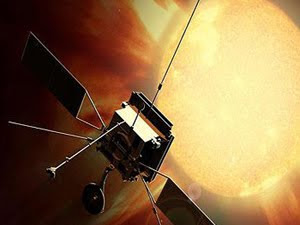
 NASA has begun development of a mission to visit and study the sun closer than ever before. The unprecedented project, named Solar Probe Plus, is slated to launch no later than 2018. The small car-sized spacecraft will plunge directly into the sun's atmosphere approximately four million miles from our star's surface. It will explore a region no other spacecraft ever has encountered. NASA has selected five science investigations that will unlock the sun's biggest mysteries. "The experiments selected for Solar Probe Plus are specifically designed to solve two key questions of solar physics why is the sun's outer atmosphere so much hotter than the sun's visible surface and what propels the solar wind that affects Earth and our solar system? " said Dick Fisher.
As the spacecraft approaches the sun, its revolutionary carbon-composite heat shield must withstand temperatures exceeding 2550 degrees Fahrenheit and blasts of intense radiation. The spacecraft will have an up close and personal view of the sun enabling scientists to better understand, characterize and forecast the radiation environment for future space explorers. NASA invited researchers in 2009 to submit science proposals. Thirteen were reviewed by a panel of NASA and outside scientists. The total dollar amount for the five selected investigations is approximately $180 million for preliminary analysis, design, development and tests.The selected proposals are:
Solar Wind Electrons Alphas and Protons Investigation: principal investigator, Justin C. Kasper, Smithsonian Astrophysical Observatory in Cambridge, Mass. This investigation will specifically count the most abundant particles in the solar wind electrons, protons and helium ions and measure their properties. The investigation also is designed to catch some of the particles in a special cup for direct analysis. Wide-field Imager: principal investigator, Russell Howard, Naval Research Laboratory in Washington. This telescope will make 3-D images of the sun's corona, or atmosphere. The experiment actually will see the solar wind and provide 3-D images of clouds and shocks as they approach and pass the spacecraft. This investigation complements instruments on the spacecraft providing direct measurements by imaging the plasma the other instruments sample.
NASA has begun development of a mission to visit and study the sun closer than ever before. The unprecedented project, named Solar Probe Plus, is slated to launch no later than 2018. The small car-sized spacecraft will plunge directly into the sun's atmosphere approximately four million miles from our star's surface. It will explore a region no other spacecraft ever has encountered. NASA has selected five science investigations that will unlock the sun's biggest mysteries. "The experiments selected for Solar Probe Plus are specifically designed to solve two key questions of solar physics why is the sun's outer atmosphere so much hotter than the sun's visible surface and what propels the solar wind that affects Earth and our solar system? " said Dick Fisher.
As the spacecraft approaches the sun, its revolutionary carbon-composite heat shield must withstand temperatures exceeding 2550 degrees Fahrenheit and blasts of intense radiation. The spacecraft will have an up close and personal view of the sun enabling scientists to better understand, characterize and forecast the radiation environment for future space explorers. NASA invited researchers in 2009 to submit science proposals. Thirteen were reviewed by a panel of NASA and outside scientists. The total dollar amount for the five selected investigations is approximately $180 million for preliminary analysis, design, development and tests.The selected proposals are:
Solar Wind Electrons Alphas and Protons Investigation: principal investigator, Justin C. Kasper, Smithsonian Astrophysical Observatory in Cambridge, Mass. This investigation will specifically count the most abundant particles in the solar wind electrons, protons and helium ions and measure their properties. The investigation also is designed to catch some of the particles in a special cup for direct analysis. Wide-field Imager: principal investigator, Russell Howard, Naval Research Laboratory in Washington. This telescope will make 3-D images of the sun's corona, or atmosphere. The experiment actually will see the solar wind and provide 3-D images of clouds and shocks as they approach and pass the spacecraft. This investigation complements instruments on the spacecraft providing direct measurements by imaging the plasma the other instruments sample.
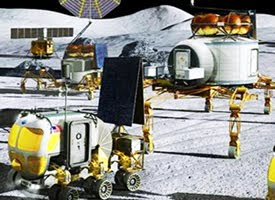
NASA and the National Space Grant Foundation have selected university teams from Maryland, Oklahoma and Wisconsin as finalists in a competition to design, manufacture, assemble and test an inflatable loft. NASA is challenging college students to design and rapidly develop prototype concepts for inflatable habitat lofts for the next generation of space explorers. The loft will be integrated onto an existing NASA operational hard-shell prototype habitat. The winning concepts may be applied to space exploration habitats of the future. "This competition gives these students the opportunity of a lifetime," said NASA Chief Technologist Bobby Braun at NASA Headquarters in Washington. "They'll design and build new hardware. If their team wins, they'll get the chance to integrate their designs into a NASA hard shell habitat and see it field tested next summer."
The inaugural eXploration Habitat, or X-Hab, Academic Innovation Challenge finalists are:
Oklahoma State University
University of Wisconsin-Madison
University of Maryland
The competition is a university-level challenge designed to encourage studies in spaceflight-related engineering and architecture disciplines. This design competition requires undergraduate and graduate students to explore NASA's work to develop space habitats, while also helping the agency gather new and innovative ideas to complement current research and development. In June 2011 at NASA's Johnson Space Center in Houston, the NASA-Habitat Demonstration Unit project will conduct a head-to-head competition among the three teams to successfully demonstrate an attachable inflatable habitat "loft" concept, based on a list of NASA requirements for the design. The Houston competition will determine the winning team, which will be awarded additional funds to integrate their design with the NASA habitat during field testing in August and September 2011.
View this site : Property auctions

NASA will host LAUNCH: Health, a global forum focusing on health issues, at the agency's Kennedy Space Center in Florida from Oct. 30-31. NASA, the U.S. Agency for International Development, the U.S. Department of State, and NIKE are partnering on LAUNCH to identify, showcase and support innovative approaches to sustainability challenges through a series of forums. LAUNCH forums focus on key areas, including water, air, food, and energy. They provide a venue for evaluating creative ideas among peers and collaborative, solution-driven discussions.This second forum, LAUNCH: Health, will bring together entrepreneurs from around the world who will be selected based on their innovative approaches to addressing health issues.
During the two-and-a-half day forum, they will discuss their proposed solutions to health issues with "council members" who represent business, policy, engineering, science, communications and sustainability sectors. The sessions are designed to identify challenges and discuss future opportunities for entrepreneurs' innovations.
LAUNCH: Health seeks transformative innovations to improve health and the quality of life on Earth, specifically for people in the first 20 years of life, in the following categories:
- Nutrition and food
- Physical activity
- Preventive health care
"NASA's interest in technology development and problem solving in the area of human health issues makes hosting this discussion among innovators and thought leaders a natural fit," NASA's Deputy Administrator Lori Garver said. "Solutions to health issues here on Earth have the potential to benefit space explorers of the future, as well as humankind overall." Problem solvers can submit their ideas through the InnoCentive website, which allows NASA to collaborate with people throughout the world who are interested in sustainability issues. Challenges are posted online for which problem solvers can submit solutions.
 NASA has begun development of a mission to visit and study the sun closer than ever before. The unprecedented project, named Solar Probe Plus, is slated to launch no later than 2018. The small car-sized spacecraft will plunge directly into the sun's atmosphere approximately four million miles from our star's surface. It will explore a region no other spacecraft ever has encountered. NASA has selected five science investigations that will unlock the sun's biggest mysteries. "The experiments selected for Solar Probe Plus are specifically designed to solve two key questions of solar physics why is the sun's outer atmosphere so much hotter than the sun's visible surface and what propels the solar wind that affects Earth and our solar system? " said Dick Fisher.

