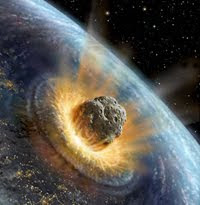
Late last year, astronomers noticed an asteroid named Scheila had unexpectedly brightened, and it was sporting short-lived plumes. Data from NASA's Swift satellite and Hubble Space Telescope showed these changes likely occurred after Scheila was struck by a much smaller asteroid. "Collisions between asteroids create rock fragments, from fine dust to huge boulders, that impact planets and their moons," said Dennis Bodewits, an astronomer at the University of Maryland in College Park and lead author of the Swift study. "Yet this is the first time we've been able to catch one just weeks after the smash-up, long before the evidence fades away."
Asteroids are rocky fragments thought to be debris from the formation and evolution of the solar system approximately 4.6 billion years ago. Millions of them orbit the sun between Mars and Jupiter in the main asteroid belt. Scheila is approximately 70 miles across and orbits the sun every five years. "The Hubble data are most simply explained by the impact, at 11,000 mph, of a previously unknown asteroid about 100 feet in diameter," said Hubble team leader David Jewitt at the University of California in Los Angeles. Hubble did not see any discrete collision fragments, unlike its 2009 observations of P/2010 A2, the first identified asteroid collision.
The studies will appear in the May 20 edition of The Astrophysical Journal Letters and are available online. Astronomers have known for decades that comets contain icy material that erupts when warmed by the sun. They regarded asteroids as inactive rocks whose destinies, surfaces, shapes and sizes were determined by mutual impacts. However, this simple picture has grown more complex over the past few years. During certain parts of their orbits, some objects, once categorized as asteroids, clearly develop comet-like features that can last for many months. Others display much shorter outbursts. Icy materials may be exposed occasionally, either by internal geological processes or by an external one, such as an impact.

Astronomers have caught sight of an unusual galaxy that has illuminated new details about a celestial "sandbar" connecting two massive islands of galaxies. The research was conducted in part with NASA's Spitzer Space Telescope. These "sandbars," or filaments, are known to span vast distances between galaxy clusters and form a lattice-like structure known as the cosmic web. Though immense, these filaments are difficult to see and study in detail. Two years ago, Spitzer's infrared eyes revealed that one such intergalactic filament containing star-forming galaxies ran between the galaxy clusters called Abell 1763 and Abell 1770.
Now these observations have been bolstered by the discovery, inside this same filament, of a galaxy that has a rare boomerang shape and unusual light emissions. Hot gas is sweeping the wandering galaxy into this shape as it passes through the filament, presenting a new way to gauge the filament's particle density. Researchers hope that other such galaxies with oddly curved profiles could serve as signposts for the faint threads, which in turn signify regions ripe for forming stars.
"These filaments are integral to the evolution of galaxy clusters among the biggest gravitationally bound objects in the universe as well as the creation of new generations of stars," said Louise Edwards, a postdoctoral researcher at the California Institute of Technology in Pasadena, and lead author of a study detailing the findings in the Dec. 1 issue of the Astrophysical Journal Letters. Her collaborators are Dario Fadda, also at Caltech, and Dave Frayer from the National Science Foundation's National Radio Astronomy Observatory, based in Charlottesville, Virginia.
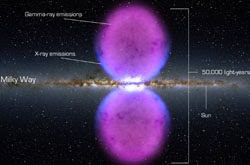
NASA's Fermi Gamma-ray Space Telescope has unveiled a previously unseen structure centered in the Milky Way. The feature spans 50,000 light-years and may be the remnant of an eruption from a supersized black hole at the center of our galaxy. "What we see are two gamma-ray-emitting bubbles that extend 25,000 light-years north and south of the galactic center," said Doug Finkbeiner, an astronomer at the Harvard-Smithsonian Center for Astrophysics in Cambridge, Mass., who first recognized the feature. "We don't fully understand their nature or origin." The structure spans more than half of the visible sky, from the constellation Virgo to the constellation Grus, and it may be millions of years old. A paper about the findings has been accepted for publication in The Astrophysical Journal.
Finkbeiner and his team discovered the bubbles by processing publicly available data from Fermi's Large Area Telescope (LAT). The LAT is the most sensitive and highest-resolution gamma-ray detector ever launched. Gamma rays are the highest-energy form of light. Other astronomers studying gamma rays hadn't detected the bubbles partly because of a fog of gamma rays that appears throughout the sky. The fog happens when particles moving near the speed of light interact with light and interstellar gas in the Milky Way. The LAT team constantly refines models to uncover new gamma-ray sources obscured by this so-called diffuse emission. By using various estimates of the fog, Finkbeiner and his colleagues were able to isolate it from the LAT data and unveil the giant bubbles.
Scientists now are conducting more analyses to better understand how the never-before-seen structure was formed. The bubble emissions are much more energetic than the gamma-ray fog seen elsewhere in the Milky Way. The bubbles also appear to have well-defined edges. The structure's shape and emissions suggest it was formed as a result of a large and relatively rapid energy release - the source of which remains a mystery. One possibility includes a particle jet from the supermassive black hole at the galactic center. In many other galaxies, astronomers see fast particle jets powered by matter falling toward a central black hole. While there is no evidence the Milky Way's black hole has such a jet today, it may have in the past. The bubbles also may have formed as a result of gas outflows from a burst of star formation, perhaps the one that produced many massive star clusters in the Milky Way's center several million years ago.
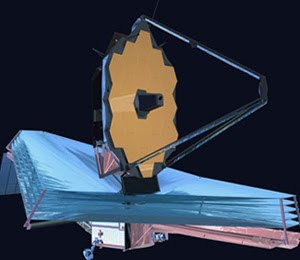
It takes years to bring a real large space telescope from basic concept to hardware reality. First, a scientist comes up with an idea to study some aspect of the Earth or the cosmos. The idea is discussed, reviewed and developed by committees of scientists. It is proposed to NASA, who makes decisions on what missions to go forth on, and which missions to pass on. If a mission is selected for study a timeline is created to develop the mission. One of the most difficult aspects of creating a new mission is convincing others to fund it. Once a mission is funded, the team of scientists and engineers "pitching" the mission can then investigate how it could come together.
Later, NASA usually selects a prime contractor to help design the telescope and other systems that will fly on the satellite. Northrop Grumman was selected to build components for the Webb telescope. The instruments, or cameras, on the telescope are selected as well, with teams of scientists to watch over the design. The design process usually includes a number of different designs, which are all tested to see which would yield the best result for the type of object the instrument would study. For example, various types of infrared cameras may be developed and tested, and the one that gives a scientist the best result, would be chosen to be built as a test unit.
Engineering test units, or ETUs are created before an actual instrument is built, so that engineers and scientists can make sure it would work properly. ETUs are a replica of the flight unit that can perform certain flight functions for testing purposes. ETUs are also used when engineers are practicing installation of an instrument into a satellite's mainframe or "bus." The outcome of the tests on ETUs may lead to a change in handling procedures of the actual flight instrument, but not a change in its flight construction. Once the ETUs test successful, then the actual instruments that will fly aboard a satellite or space telescope can be manufactured.
View this site :
Property auctions
 Tight double-star systems might not be the best places for life to spring up, according to a new study using data from NASA's Spitzer Space Telescope. The infrared observatory spotted a surprisingly large amount of dust around three mature, close-orbiting star pairs. Where did the dust come from? Astronomers say it might be the aftermath of tremendous planetary collisions. "This is real-life science fiction," said Jeremy Drake of the Harvard-Smithsonian Center for Astrophysics, Cambridge, Mass. "Our data tell us that planets in these systems might not be so lucky collisions could be common. It's theoretically possible that habitable planets could exist around these types of stars, so if there happened to be any life there, it could be doomed."
Drake is the principal investigator of the research, published in the Aug.19 issue of the Astrophysical Journal Letters. The particular class of binary, or double, stars in the study are about as snug as stars get. Named RS Canum Venaticorums, or RS CVns for short, they are separated by only about two million miles (3.2 million kilometers), or two percent of the distance between Earth and our sun. The stellar pairs orbit around each other every few days, with one face on each star perpetually locked and pointed toward the other. The close-knit stars are similar to the sun in size and are probably about a billion to a few billion years old roughly the age of our sun when life first evolved on Earth. But these stars spin much faster, and, as a result, have powerful magnetic fields, and giant, dark spots.
The magnetic activity drives strong stellar winds gale-force versions of the solar wind that slow the stars down, pulling the twirling duos closer over time. And this is where the planetary chaos may begin. As the stars cozy up to each other, their gravitational influences change, and this could cause disturbances to planetary bodies orbiting around both stars. Comets and any planets that may exist in the systems would start jostling about and banging into each other, sometimes in powerful collisions. This includes planets that could theoretically be circling in the double stars' habitable zone, a region where temperatures would allow liquid water to exist. Though no habitable planets have been discovered around any stars beyond our sun at this point in time, tight double-star systems are known to host planets; for example, one system not in the study, called HW Vir, has two gas-giant planets.

A new image of two tangled galaxies has been released by NASA's Great Observatories. The Antennae galaxies, located about 62 million light-years from Earth, are shown in this composite image from the Chandra X-ray Observatory (blue), the Hubble Space Telescope (gold and brown), and the Spitzer Space Telescope (red). The Antennae galaxies take their name from the long, antenna-like arms seen in wide-angle views of the system. These features were produced in the collision. The collision, which began more than 100 million years ago and is still occurring, has triggered the formation of millions of stars in clouds of dusts and gas in the galaxies.
The most massive of these young stars have already sped through their evolution in a few million years and exploded as supernovas. The X-ray image from Chandra shows huge clouds of hot, interstellar gas, which have been injected with rich deposits of elements from supernova explosions. This enriched gas, which includes elements such as oxygen, iron, magnesium and silicon, will be incorporated into new generations of stars and planets. The bright, point-like sources in the image are produced by material falling onto black holes and neutron stars that are remnants of the massive stars. Some of these black holes may have masses that are almost one hundred times that of the sun.
The Spitzer data show infrared light from warm dust clouds that have been heated by newborn stars, with the brightest clouds lying in the overlap region between the two galaxies. The Hubble data reveal old stars and star-forming regions in gold and white, while filaments of dust appear in brown. Many of the fainter objects in the optical image are clusters containing thousands of stars. NASA's Jet Propulsion Laboratory, Pasadena, Calif., manages the Spitzer Space Telescope mission for NASA's Science Mission Directorate, Washington. Science operations are conducted at the Spitzer Science Center at the California Institute of Technology, also in Pasadena. Caltech manages JPL for NASA.

Astronomers using NASA's Spitzer Space Telescope have discovered carbon molecules, known as "buckyballs," in space for the first time. Buckyballs are soccer-ball-shaped molecules that were first observed in a laboratory 25 years ago. They are named for their resemblance to architect Buckminster Fuller's geodesic domes, which have interlocking circles on the surface of a partial sphere. Buckyballs were thought to float around in space, but had escaped detection until now.
"We found what are now the largest molecules known to exist in space," said astronomer Jan Cami of the University of Western Ontario, Canada, and the SETI Institute in Mountain View, Calif. "We are particularly excited because they have unique properties that make them important players for all sorts of physical and chemical processes going on in space." Cami has authored a paper about the discovery that will appear online Thursday in the journal Science.
Buckyballs are made of 60 carbon atoms arranged in three-dimensional, spherical structures. Their alternating patterns of hexagons and pentagons match a typical black-and-white soccer ball. The research team also found the more elongated relative of buckyballs, known as C70, for the first time in space. These molecules consist of 70 carbon atoms and are shaped more like an oval rugby ball. Both types of molecules belong to a class known officially as buckminsterfullerenes, or fullerenes. The Cami team unexpectedly found the carbon balls in a planetary nebula named Tc 1. Planetary nebulas are the remains of stars, like the sun, that shed their outer layers of gas and dust as they age.

Astronomers using NASA's Hubble Space Telescope have confirmed the existence of a baked object that could be called a "cometary planet." The gas giant planet, named HD 209458b, is orbiting so close to its star that its heated atmosphere is escaping into space. Observations taken with Hubble's Cosmic Origins Spectrograph (COS) suggest powerful stellar winds are sweeping the cast-off atmospheric material behind the scorched planet and shaping it into a comet-like tail.
"Since 2003 scientists have theorized the lost mass is being pushed back into a tail, and they have even calculated what it looks like," said astronomer Jeffrey Linsky of the University of Colorado in Boulder, leader of the COS study. "We think we have the best observational evidence to support that theory. We have measured gas coming off the planet at specific speeds, some coming toward Earth. The most likely interpretation is that we have measured the velocity of material in a tail."
The planet, located 153 light years from Earth, weighs slightly less than Jupiter but orbits 100 times closer to its star than the Jovian giant. The roasted planet zips around its star in a short 3.5 days. In contrast, our solar system's fastest planet, Mercury, orbits the sun in 88 days. The extrasolar planet is one of the most intensely scrutinized, because it is the first of the few known alien worlds that can be seen passing in front of, or transiting, its star. Linsky and his team used COS to analyze the planet's atmosphere during transiting events.

A dragon-shaped cloud of dust seems to fly with the stars in a new image from NASA's Spitzer Space Telescope (bottom). In visible light (top), the creature disappears into the clouds perhaps it's "frolicking in the autumn mist" like Puff, the Magic Dragon, from the famous Peter, Paul and Mary song. The infrared image has revealed that this creature, a dark cloud called M17 SWex, is forming stars at a furious rate but has not yet spawned the most massive type of stars, known as O stars.
Such stellar behemoths, however, light up the M17 nebula at the image's center and have also blown a huge "bubble" in the gas and dust that forms M17's luminous left edge. The stars and gas in this region are now passing though the Sagittarius spiral arm of the Milky Way , touching off a galactic "domino effect." The youngest episode of star formation is playing out inside the dusty dragon as it enters the spiral arm. Over time, this area will flare up like the bright M17 nebula, glowing in the light of young massive stars.
An older burst of star formation blew the bubble seen in the region to the far left, called M17 EB. The visible-light view of the area clearly shows the bright M17 nebula, as well as the glowing hot gas filling the "bubble" to its left. However the M17 SWex "dragon" is hidden within dust clouds that are opaque to visible light. It takes an infrared view to catch the light from these shrouded regions and reveal the earliest stages of star formation.

After a long and successful career providing communications support, NASA's groundbreaking Tracking and Data Relay Satellite (TDRS) 1 is retiring. On Sunday, June 27, NASA will shut down the satellite that launched into orbit during space shuttle Challenger’s maiden voyage (STS-6) in April 1983. From 1983 to 1998, TDRS-1 provided NASA with the ability to communicate with other satellites in orbit. NASA reassigned TDRS-1 in 1998 to support the National Science Foundation's (NSF) U.S. Antarctic Program and others on scientific, educational and operational endeavors.
TDRS-1 worked with eight additional satellites to relay data and communications from more than 15 customers, including the NSF, the Hubble Space Telescope, the shuttle and the International Space Station. The TDRS system provides the capability not only to send commands and receive data, but also to navigate and talk with crews in orbit.
"TDRS-1 paved the way for this incredible space communications system," said Bill Gerstenmaier, associate administrator for NASA's Space Operations Mission Directorate. "The remaining TDRS satellites, and the new satellites that will be online within three years, will carry on these critical capabilities for many NASA missions, including science and human spaceflight."


