 In communities all across the U.S., travelers that went to the moon and back with the Apollo 14 mission are living out their quiet lives. The whereabouts of more than 50 are known. Many, now aging, reside in prime retirement locales: Florida, Arizona and California. A few are in the Washington, D.C., area. Hundreds more are out there or at least, they were. And Dave Williams of NASA's Goddard Space Flight Center in Greenbelt, Md., wants to find them before it's too late. The voyagers in question are not astronauts. They're "moon trees" redwood, loblolly pine, sycamore, Douglas fir, and sweetgum trees sprouted from seeds that astronaut Stuart Roosa took to the moon and back 40 years ago.
"Hundreds of moon trees were distributed as seedlings," says Williams, "but we don't have systematic records showing where they all went." And though some of the trees are long-lived species expected to live hundreds or thousands of years, others have started to succumb to the pressures of old age, severe weather and disease. At least a dozen have died, including the loblolly pine at the White House and a New Orleans pine that was damaged by Hurricane Katrina and later removed. To capture the vanishing historical record, Williams, a curator at the National Space Science Data Center, has been tracking down the trees, dead or alive.
His sleuthing started in 1996, prompted by an email from a third-grade teacher, Joan Goble, asking about a tree at the Camp Koch Girl Scout Camp in Cannelton, Ind. A simple sign nearby read "moon tree." "At the time, I had never heard of moon trees," Williams says. "The sign had a few clues, so I sent a message to the NASA history office and found more bits and pieces on the web. Then I got in touch with Stan Krugman and got more of the story." Krugman had been the U.S. Department of Agriculture Forest Service's staff director for forest genetics research in 1971. He had given the seeds to Roosa, who stowed them in his personal gear for the Apollo 14 mission. The seeds were symbolic for Roosa because he had fought wildfires as a smoke jumper before becoming an Air Force test pilot and then an astronaut.

What are you doing for the holidays this winter? Spending time with family and friends? More than a dozen Near Earth Network engineers and support personnel from NASA’s Goddard Space Flight Center in Greenbelt, Md., and Wallops Flight Facility in Va., will be packing their bags and spending their holidays far away from their families at McMurdo Station, Antarctica, for the austral summer. McMurdo Station is one of three permanent National Science Foundation (NSF) stations in Antarctica. At McMurdo Station, which is the main U.S. station in Antarctica and 850 miles (1,360 km) north of the South Pole, the mean annual temperature is 0 F (-18 C). Temperatures can reach 46 F (8 C) in the austral summer and -58 F (-50 C) in the austral winter. The average wind is 14 miles per hour, but winds have exceeded 115 miles per hour.
The team will perform crucial upgrades and maintenance activities to the NASA Near Earth Network at McMurdo Ground Station in support of European Space Agency’s latest meteorological satellite, MetOp, which launched in October 2006. MetOp-A is the first in a series of three European meteorological operational satellites procured by ESA to serve as the space segment of the European Organisation for the Exploitation of Meteorological Satellites' EUMETSAT Polar System. Under a memorandum of agreement between NASA and the National Oceanic and Atmospheric Administration , the McMurdo Ground Station’s support will begin in March 2011 and also will support MetOp-B and C over the next 15 years.
In collaboration with the NSF, NASA owns and operates a single 10-meter antenna, hidden inside the radome in this photo, and associated electronics equipment that has provided countless hours of space to ground communications support to dozens of Expendable Launch Vehicles and polar-orbiting satellites owned by NASA, other government agencies and international partners. In addition to having a station at McMurdo, the Near Earth Network combines other NASA-owned stations with services purchased from commercially owned stations to provide support to a long list of missions. The upgrades will involve replacing a majority of the electronics systems in the ground station.

NASA has awarded a five-year, $1.24 billion contract extension to The Boeing Co. to continue engineering support of the International Space Station through Sept. 30, 2015. Work under the contract extension is intended to maintain the station at peak performance levels so the full value of the unique research laboratory is available to NASA, its international partners, other U.S. government agencies and private companies. NASA officially accepted the space station from Boeing at the conclusion of a March 2010 Acceptance Review Board that verified the delivery, assembly, integration and activation of all hardware and software required by the contract. The acceptance signified the transition from assembly of the station to utilization.
This action extends the space station’s Vehicle Sustaining Engineering Contract, which was originally awarded in January 1995 and most recently extended in 2008. The extension brings the total contract value through the end of fiscal year 2015 to $16.2 billion. Work under the contract extension will include sustaining engineering of station hardware and software, and support of U.S. hardware and software provided to international partners and participants in the station program. The extension also includes end-to-end subsystem management for the majority of station systems, including materials and processes, electrical, electronic, and electromechanical parts, environments and electromagnetic effects.
NASA and its international partner agencies are in the final stages of analyzing the ability to sustain station operations through 2020 and awaiting formal confirmation of this goal by the governments of participating countries. This contract extension also includes assessment of the feasibility of extending the life of the primary structural hardware that was installed in orbit through the end of 2028. The work will be performed at NASA's Johnson Space Center in Houston, Kennedy Space Center in Florida, Marshall Space Flight Center in Huntsville, Ala., and at other domestic and international locations.

NASA's Aqua satellite flies around the Earth twice a day and captures visible and infrared imagery. On Sept. 12 at 19:20 UTC (3:20 p.m. EDT), the Moderate Resolution Imaging Spectroradiometer (MODIS) instrument on Aqua captured a visible image of the "Reservoir Road Fire" that is currently raging in the Arapaho & Roosevelt National Forests / Pawnee National Grassland. According to the National Forest Incident report on September 13, the Reservoir Road Fire near Loveland, Colorado, has burned 600 acres, and firefighting continues. Loveland is the second most populous city in Larimer County, Colo. Loveland is located 46 miles north of Denver. MODIS is a key instrument aboard two of NASA's satellites: Aqua and Terra.
Terra MODIS and Aqua MODIS are viewing the entire Earth's surface every 1 to 2 days. These data are improving our understanding of global dynamics and processes occurring on the land, in the oceans, and in the lower atmosphere. MODIS data has been used to find smoke plumes and capture images of hurricanes and changes in glaciers. There are many applications for this data. The data from both MODIS instruments are processed into images by the MODIS Rapid Response Team located at NASA's Goddard Space Flight Center in Greenbelt, Maryland. U.S. Forest Service in Fort Collins, Colo. is reporting on the fire through their incident information system on-line, known as Inci-Web. They report today, Sept. 13, that crews and engines remained on scene over night from Sept. 12 through today, creating a line on the south side of the fire.
The fire saw little growth overnight. Additional crews will work the fire today and air operations will begin after the weather inversion lifts. The fire is burning in Larimer County, predominately on private land. Meanwhile the Fourmile Canyon Fire, which was raging last week, is 87 percent contained as of Sept. 13, according to the U.S. Forest Service website that noted: "There are still areas within the fire that are smoldering a change in weather conditions can cause the fire to flare up." That fire was about 5 miles west of downtown Boulder and affected 6,250 acres. The U.S. Forest Service also stated that the Boulder County Sheriff's Department announced that residents will be allowed into the fire area over the next several days. Information on the re-entry and the process that will be used has been posted at www.boulderOEM.com.

NASA completed a historic day for its hurricane research on Thursday as it put the Global Hawk over Earl, marking the first time the unmanned drone flew over a fully formed hurricane. The Global Hawk also flew in concert with NASA’s DC-8 during the DC-8’s fourth and final research flight to Earl. Both planes are outfitted with a suite of highly advanced instruments that scientists hope will bring new insight into how hurricanes form and intensify. Thursday marked the first day of the Genesis and Rapid Intensification Processes (GRIP) experiment when two NASA aircraft involved were flying and studying a storm at the same time. The experiment was designed to take advantage of having multiple aircraft above a storm at once, in order to observe hurricanes and tropical storms in as many facets as possible.
As Earl changed over the course of the week, the hurricane turned into an almost ideal test bed for GRIP. The DC-8 flew to Earl four times, including twice from St. Croix in order to reach it when it was farther east. GRIP scientists designed the mission in order to capture a hurricane either as it was forming or as it was strengthening or fizzling. And the Earl flights delivered, allowing scientists to observe the storm rapidly intensifying earlier in the week and then collapsing to a degree later in the week. A Sunday flight from St. Croix put the DC-8 over Earl as it intensified from a Category 1 to a Category 2. And Monday’s flight from Ft. Lauderdale allowed the DC-8’s instruments to observe what was happening as Earl went from a Category 3 to a Category 4.
One of GRIP’s key goals is to help scientists understand why and how some hurricanes rapidly intensify. These flights collected important data toward that end, scientists said. “That series of flights alone really helped us achieve a great goal, which is to observe rapid intensification,” said GRIP mission scientist Scott Braun from NASA's Goddard Space Flight Center, Greenbelt, Md. Earl had surprised scientists earlier in the week when they saw that it was surrounded by dry air. Hurricanes often derive strength from moist air and weaken when dry air infiltrates the cyclone. “What happened?” said GRIP mission scientist Ed Zipser of the University of Utah. “The storm continued to intensify in spite of that. And we need to know why.”

The universe is still an arcane place that scientists know very little about, but a new NASA Solar Terrestrial Probe mission is going to shed light on one especially mysterious event called magnetic reconnection. It occurs when magnetic lines of force cross, cancel, and reconnect releasing magnetic energy in the form of heat and charged-particle kinetic energy. On the sun, magnetic reconnection causes solar flares more powerful than several atomic bombs combined. In Earth's atmosphere, magnetic reconnection dispenses magnetic storms and auroras, and in laboratories on Earth it can cause big problems in fusion reactors.
Although the study of magnetic reconnection dates back to the 1950s and despite numerous scientific papers addressing this perplexing issue, scientists still cannot agree on one accepted model. In 2014, NASA is scheduled to launch a satellite that will greatly increase our understanding of this phenomenon when it launches the Magnetospheric Multiscale (MMS) mission, a suite of four identical spacecraft that will study magnetic reconnection in the best possible laboratory – the Earth’s magnetosphere. The spacecraft will obtain measurements necessary to test prevailing theories as to how reconnection is enabled and how it progresses.
Recently, NASA and members of an independent review board painstakingly reviewed every aspect of the MMS mission, and successfully completed the mission’s critical design review. This technical review is held to ensure that a mission can proceed into fabrication, demonstration and test and can meet stated performance requirements, including cost, schedule, risk and other system constraints. According to MMS deputy project scientist Mark Adrian of NASA’s Goddard Space Flight Center in Greenbelt, Md., “This is the last hurdle before the spacecraft and instrument teams begin to build actual flight hardware.” MMS was approved for implementation in June 2009 following a successful Preliminary Design Review in May 2009.
 With a loud roar and mighty column of flame, NASA and ATK Aerospace Systems successfully completed a two-minute, full-scale test of the largest and most powerful solid rocket motor designed for flight. The motor is potentially transferable to future heavy-lift launch vehicle designs. The stationary firing of the first-stage development solid rocket motor, dubbed DM-2, was conducted by ATK, a division of Alliant Techsystems of Brigham City, Utah. DM-2 is the most heavily instrumented solid rocket motor in NASA history, with a total of 53 test objectives measured through more than 760 instruments. Prior to the static test, the solid rocket motor was cooled to 40 degrees Fahrenheit to verify the performance of new materials and assess motor performance at low temperatures during the full-duration test.
Initial test data showed the motor performance met all expectations. "For every few degrees the temperature rises, solid propellant burns slightly faster and only through robust ground testing can we understand how material and motor performance is impacted by different operating conditions," said Alex Priskos, first stage manager for Ares Projects at NASA's Marshall Space Flight Center in Huntsville, Ala. "Ground-testing at temperature extremes pushes this system to its limits, which advances our understanding of five-segment solid rocket motor performance." The first-stage solid rocket motor is designed to generate up to 3.6-million pounds of thrust at launch. Information collected from this test, together with data from the first development motor test last year, will be evaluated to better understand the performance and reliability of the design.
Although similar to the solid rocket boosters that help power the space shuttle to orbit, the five-segment development motor includes several upgrades and technology improvements implemented by NASA and ATK engineers. Motor upgrades from a shuttle booster include the addition of a fifth segment, a larger nozzle throat, and upgraded insulation and liner. The motor cases are flight-proven hardware used on shuttle launches for more than three decades. The cases used in this ground test have collectively launched 59 previous missions. After more testing, the first-stage solid rocket motor will be certified to fly at temperature ranges between 40-90 degrees Fahrenheit. The solid rocket motor was built as an element of NASA's Constellation Program and is managed by the Ares Projects Office at Marshall. ATK Aerospace Systems is the prime contractor.
With a loud roar and mighty column of flame, NASA and ATK Aerospace Systems successfully completed a two-minute, full-scale test of the largest and most powerful solid rocket motor designed for flight. The motor is potentially transferable to future heavy-lift launch vehicle designs. The stationary firing of the first-stage development solid rocket motor, dubbed DM-2, was conducted by ATK, a division of Alliant Techsystems of Brigham City, Utah. DM-2 is the most heavily instrumented solid rocket motor in NASA history, with a total of 53 test objectives measured through more than 760 instruments. Prior to the static test, the solid rocket motor was cooled to 40 degrees Fahrenheit to verify the performance of new materials and assess motor performance at low temperatures during the full-duration test.
Initial test data showed the motor performance met all expectations. "For every few degrees the temperature rises, solid propellant burns slightly faster and only through robust ground testing can we understand how material and motor performance is impacted by different operating conditions," said Alex Priskos, first stage manager for Ares Projects at NASA's Marshall Space Flight Center in Huntsville, Ala. "Ground-testing at temperature extremes pushes this system to its limits, which advances our understanding of five-segment solid rocket motor performance." The first-stage solid rocket motor is designed to generate up to 3.6-million pounds of thrust at launch. Information collected from this test, together with data from the first development motor test last year, will be evaluated to better understand the performance and reliability of the design.
Although similar to the solid rocket boosters that help power the space shuttle to orbit, the five-segment development motor includes several upgrades and technology improvements implemented by NASA and ATK engineers. Motor upgrades from a shuttle booster include the addition of a fifth segment, a larger nozzle throat, and upgraded insulation and liner. The motor cases are flight-proven hardware used on shuttle launches for more than three decades. The cases used in this ground test have collectively launched 59 previous missions. After more testing, the first-stage solid rocket motor will be certified to fly at temperature ranges between 40-90 degrees Fahrenheit. The solid rocket motor was built as an element of NASA's Constellation Program and is managed by the Ares Projects Office at Marshall. ATK Aerospace Systems is the prime contractor.
View this site : Property auctions

With a loud roar and mighty column of flame, NASA and ATK Aerospace Systems successfully completed a two-minute, full-scale test of the largest and most powerful solid rocket motor designed for flight. The motor is potentially transferable to future heavy-lift launch vehicle designs. The stationary firing of the first-stage development solid rocket motor, dubbed DM-2, was the most heavily instrumented solid rocket motor test in NASA history. More than 760 instruments measured 53 test objectives. Prior to the static test, the solid rocket motor was cooled to 40 degrees Fahrenheit to verify the performance of new materials and assess motor performance at low temperatures during the full-duration test. Initial test data showed the motor performance met all expectations.
"For every few degrees the temperature rises, solid propellant burns slightly faster and only through robust ground testing can we understand how material and motor performance is impacted by different operating conditions," said Alex Priskos, first stage manager for Ares Projects at NASA's Marshall Space Flight Center in Huntsville, Ala. "Ground-testing at temperature extremes pushes this system to its limits, which advances our understanding of five-segment solid rocket motor performance." The first-stage solid rocket motor is designed to generate up to 3.6-million pounds of thrust at launch. Information collected from this test, together with data from the first development motor test last year, will be evaluated to better understand the performance and reliability of the design.
Although similar to the solid rocket boosters that help power the space shuttle to orbit, the five-segment development motor includes several upgrades and technology improvements implemented by NASA and ATK engineers. Motor upgrades from a shuttle booster include the addition of a fifth segment, a larger nozzle throat, and upgraded insulation and liner. The motor cases are flight-proven hardware used on shuttle launches for more than three decades. The cases used in this ground test have collectively launched 59 previous missions, the earliest being STS-3. After more testing, the first-stage solid rocket motor will be certified to fly at temperature ranges between 40-90 degrees Fahrenheit. The solid rocket motor was built as an element of NASA's Constellation Program and is managed by the Ares Projects Office at Marshall. ATK Aerospace Systems, a division of Alliant Techsystems of Brigham City, Utah, is the prime contractor.
 A new geologic map of the moon's Schrödinger basin paints an instant, camouflage-colored portrait of what a mash-up the moon's surface is after eons of violent events. The geologic record at Schrödinger is still relatively fresh because the basin is only about 3.8 billion years old; this makes it the moon's second-youngest large basin. Schrödinger is located near the moon's south pole, a region where pockets of permanent ice are thought to exist. The map will help researchers understand lunar geologic history and identify suitable landing sites for future exploration. Scott Mest, a research scientist with the Planetary Science Institute working at NASA's Goddard Space Flight Center in Greenbelt, Md., and his colleagues created this geologic map the most detailed one to date by combining topographic data from the Lunar Orbiter Laser Altimeter, with images and spectral data from the earlier Clementine and Lunar Prospector missions.
Schrödinger is an example of an intriguing type of basin called a peak-ring. Like the basin rim (brown outer ring), the smaller and more fragmented peak ring (brown inner ring) is a mountainous region of crust that rose up after a huge object, probably measuring 35-40 kilometers, or about 21-25 miles, smacked into the moon here. These areas of raised crust are the oldest rocks in the basin and just about the only material that wasn't melted by the heat from the object's impact. The melted material was spewed in all directions and formed the plains. Patches of plains material can have slightly different textures and albedo (indicated by dark green and kelly green), probably because they cooled at different times. Fractures (black lines) formed in the basin floor as the material cooled.
Schrödinger Basin is one of the few areas near the moon's south pole with evidence of recent volcanic activity. This includes lava flows from volcanic activity on the surface (beige areas) as well as explosive eruptions from a vent inside the red area; this vent has brought up dark material that mantles the plains (red area, which is newer than the beige regions). Older volcanic material is spread over a wider range (gray and lime green). More recent cratering by smaller objects has scattered material (yellow areas) near the top of the basin. Next to that (very light green beside yellow) is a region with a knobby texture that suggests loose material that could have come from cratering outside the basin or from a landslide on the basin's rim.
A new geologic map of the moon's Schrödinger basin paints an instant, camouflage-colored portrait of what a mash-up the moon's surface is after eons of violent events. The geologic record at Schrödinger is still relatively fresh because the basin is only about 3.8 billion years old; this makes it the moon's second-youngest large basin. Schrödinger is located near the moon's south pole, a region where pockets of permanent ice are thought to exist. The map will help researchers understand lunar geologic history and identify suitable landing sites for future exploration. Scott Mest, a research scientist with the Planetary Science Institute working at NASA's Goddard Space Flight Center in Greenbelt, Md., and his colleagues created this geologic map the most detailed one to date by combining topographic data from the Lunar Orbiter Laser Altimeter, with images and spectral data from the earlier Clementine and Lunar Prospector missions.
Schrödinger is an example of an intriguing type of basin called a peak-ring. Like the basin rim (brown outer ring), the smaller and more fragmented peak ring (brown inner ring) is a mountainous region of crust that rose up after a huge object, probably measuring 35-40 kilometers, or about 21-25 miles, smacked into the moon here. These areas of raised crust are the oldest rocks in the basin and just about the only material that wasn't melted by the heat from the object's impact. The melted material was spewed in all directions and formed the plains. Patches of plains material can have slightly different textures and albedo (indicated by dark green and kelly green), probably because they cooled at different times. Fractures (black lines) formed in the basin floor as the material cooled.
Schrödinger Basin is one of the few areas near the moon's south pole with evidence of recent volcanic activity. This includes lava flows from volcanic activity on the surface (beige areas) as well as explosive eruptions from a vent inside the red area; this vent has brought up dark material that mantles the plains (red area, which is newer than the beige regions). Older volcanic material is spread over a wider range (gray and lime green). More recent cratering by smaller objects has scattered material (yellow areas) near the top of the basin. Next to that (very light green beside yellow) is a region with a knobby texture that suggests loose material that could have come from cratering outside the basin or from a landslide on the basin's rim.
View this site : Property auctions
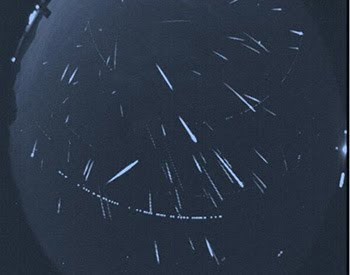 The 2010 Perseid meteor shower is drawing to a close after painting brilliant streaks across the August nighttime skies. This year's shower began around July 17, peaked August 12-13 and will be officially over by August 24. "The Perseids are a great shower, one I look forward to every year. And this year didn’t disappoint!" said Dr. Bill Cooke, head of NASA's Meteoroid Environment Office, located at the Marshall Space Flight Center in Huntsville, Ala. The Perseid meteor shower has been observed for at least 2,000 years and is associated with the comet 109P/Swift-Tuttle, which orbits the sun once every 133 years or so.
Each year in August, the Earth passes through a cloud of the comet's debris. These bits of ice and dust travel around 132,000 mph, burning up about 56 miles overhead in the Earth's atmosphere to create one of the best meteor showers of the year. The shower is called the "Perseids" because the meteors appear to come from the direction of the constellation Perseus. The Perseids can be of any brightness, but most are as bright as Polaris North Star or brighter. This meteor shower, however, is known for producing "fireball" meteors that appear at least as bright as the planet Venus as they burn up in the night sky. The bits of Swift-Tuttle debris range in size from one millimeter to several centimeters the larger the particle hitting the Earth's atmosphere, the brighter the meteor trail.
The streak of light in a meteor trail isn’t a view of the particle, but the ionization trail. Ionization happens as the speeding particle causes electrons to be ripped away from atoms in the atmosphere. The meteor trails from a Perseid meteor can be many miles long and remain visible for several seconds. If you missed the Perseids this year, another good meteor shower is coming in December. The Geminids will happen between Dec. 7-17, with the best viewing after moonset Dec. 13-14. The forecast is for 50-120 meteors per hour at the peak on Dec. 14 at roughly 2 in the morning. The Geminids are named for the constellation Gemini, the direction from which the meteors appear to originate.
The 2010 Perseid meteor shower is drawing to a close after painting brilliant streaks across the August nighttime skies. This year's shower began around July 17, peaked August 12-13 and will be officially over by August 24. "The Perseids are a great shower, one I look forward to every year. And this year didn’t disappoint!" said Dr. Bill Cooke, head of NASA's Meteoroid Environment Office, located at the Marshall Space Flight Center in Huntsville, Ala. The Perseid meteor shower has been observed for at least 2,000 years and is associated with the comet 109P/Swift-Tuttle, which orbits the sun once every 133 years or so.
Each year in August, the Earth passes through a cloud of the comet's debris. These bits of ice and dust travel around 132,000 mph, burning up about 56 miles overhead in the Earth's atmosphere to create one of the best meteor showers of the year. The shower is called the "Perseids" because the meteors appear to come from the direction of the constellation Perseus. The Perseids can be of any brightness, but most are as bright as Polaris North Star or brighter. This meteor shower, however, is known for producing "fireball" meteors that appear at least as bright as the planet Venus as they burn up in the night sky. The bits of Swift-Tuttle debris range in size from one millimeter to several centimeters the larger the particle hitting the Earth's atmosphere, the brighter the meteor trail.
The streak of light in a meteor trail isn’t a view of the particle, but the ionization trail. Ionization happens as the speeding particle causes electrons to be ripped away from atoms in the atmosphere. The meteor trails from a Perseid meteor can be many miles long and remain visible for several seconds. If you missed the Perseids this year, another good meteor shower is coming in December. The Geminids will happen between Dec. 7-17, with the best viewing after moonset Dec. 13-14. The forecast is for 50-120 meteors per hour at the peak on Dec. 14 at roughly 2 in the morning. The Geminids are named for the constellation Gemini, the direction from which the meteors appear to originate.

Rain drops are fat and snowflakes are fluffy, but why does it matter in terms of predicting severe storms? We've all seen fat rain drops, skinny rain drops, round hailstones, fluffy snowflakes and even ice needles. This summer, NASA researchers are going to get a look at just how much these shapes influence severe storm weather. To do it, they'll have to look inside the guts of some of the world's fiercest storms. NASA recently assembled a team of hurricane scientists from across the country to carry out high-altitude-aircraft surveillance to explore in detail how storms form, intensify and dissipate.
Earth scientists and engineers at NASA's Marshall Space Flight Center in Huntsville, Ala., have redesigned one of their instruments, the Advanced Microwave Precipitation Radiometer, or AMPR, to better observe the different shapes of precipitation. In August and September, AMPR will fly at an altitude of 60,000 feet over the Gulf of Mexico and Atlantic Ocean. It will sit in the bomb bay of a WB-57 airplane, which is based at the NASA Johnson Space Center's Ellington Field in Houston. During these flights, AMPR researchers will test a new build the instrument is an upgraded version of the original AMPR built at NASA Marshall in the early 1990s and use it to participate in NASA's upcoming hurricane study, the Genesis and Rapid Intensification Processes field campaign, better known as GRIP.
The campaign involves three planes mounted with 14 different instruments, including AMPR. The instruments will all work together to create the most complete view of a hurricane to date. Researchers hope the hurricane campaign will help them answer some of nature's most perplexing questions. As tropical storms grow, they produce massive amounts of rain a key element in the development of full-scale hurricanes. Scientists will use AMPR along with the other instruments, such as data from the Tropical Rainfall Measuring Mission or TRMM satellite, to figure out just how hard it's raining inside these ferocious storms, and how much of that rain is associated with the production of ice during intensification.
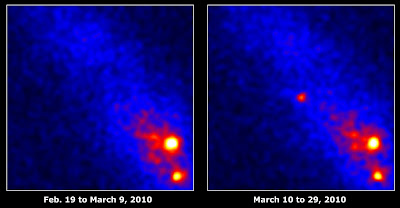
Astronomers using NASA's Fermi Gamma-ray Space Telescope have detected gamma-rays from a nova for the first time, a finding that stunned observers and theorists alike. The discovery overturns the notion that novae explosions lack the power to emit such high-energy radiation. A nova is a sudden, short-lived brightening of an otherwise inconspicuous star. The outburst occurs when a white dwarf in a binary system erupts in an enormous thermonuclear explosion. "In human terms, this was an immensely powerful eruption, equivalent to about 1,000 times the energy emitted by the sun every year," said Elizabeth Hays, a Fermi deputy project scientist at NASA's Goddard Space Flight Center in Greenbelt, Md. "But compared to other cosmic events Fermi sees, it was quite modest. We're amazed that Fermi detected it so strongly."
Gamma rays are the most energetic form of light, and Fermi's Large Area Telescope (LAT) detected the nova for 15 days. Scientists believe the emission arose as a million-mile-per-hour shock wave raced from the site of the explosion. A paper detailing the discovery will appear in the Aug. 13 edition of the journal Science. The story opened in Japan during the predawn hours of March 11, when amateur astronomers Koichi Nishiyama and Fujio Kabashima in Miyaki-cho, Saga Prefecture, imaged a dramatic change in the brightness of a star in the constellation Cygnus. They realized that the star, known as V407 Cyg, was 10 times brighter than in an image they had taken three days earlier.
The team relayed the nova discovery to Hiroyuki Maehara at Kyoto University, who notified astronomers around the world for follow-up observations. Before this notice became widely available, the outburst was independently reported by three other Japanese amateurs: Tadashi Kojima, Tsumagoi-mura Agatsuma-gun, Gunma prefecture; Kazuo Sakaniwa, Higashichikuma-gun, Nagano prefecture; and Akihiko Tago, Tsuyama-shi, Okayama prefecture. On March 13, Goddard's Davide Donato was on-duty as the LAT "flare advocate," a scientist who monitors the daily data downloads for sources of potential interest, when he noticed a significant detection in Cygnus. But linking this source to the nova would take several days, in part because key members of the Fermi team were in Paris for a meeting of the LAT scientific collaboration.

NASA's Wide-field Infrared Survey Explorer, or WISE, is warming up. Team members say the spacecraft is running out of the frozen coolant needed to keep its heat-sensitive instrument chilled.The telescope has two coolant tanks that keep the spacecraft's normal operating temperature at 12 Kelvin. The outer, secondary tank is now depleted, causing the temperature to increase. One of WISE's infrared detectors, the longest-wavelength band most sensitive to heat, stopped producing useful data once the telescope warmed to 31 Kelvin. The primary tank still has a healthy supply of coolant, and data quality from the remaining infrared detectors remains high.
WISE completed its primary mission, a full scan of the entire sky in infrared light, on July 17, 2010. The mission has taken more than 1.5 million snapshots so far, uncovering hundreds of millions of objects, including asteroids, stars and galaxies. It has discovered more than 29,000 new asteroids to date, more than 100 near-Earth objects and 15 comets. WISE is continuing a second survey of about one-half the sky as originally planned. It's possible the remaining coolant will run out before that scan is finished. Scientists say the second scan will help identify new and nearby objects, as well as those that have changed in brightness. It could also help to confirm oddball objects picked up in the first scan.
NASA's Jet Propulsion Laboratory, Pasadena, Calif., manages the Wide-field Infrared Survey Explorer for NASA's Science Mission Directorate, Washington. The principal investigator, Edward Wright, is at UCLA. The mission was competitively selected under NASA's Explorers Program, managed by the Goddard Space Flight Center, Greenbelt, Md. The science instrument was built by the Space Dynamics Laboratory, Logan, Utah, and the spacecraft was built by Ball Aerospace & Technologies Corp., Boulder, Colo. Science operations and data processing take place at the Infrared Processing and Analysis Center at the California Institute of Technology in Pasadena. Caltech manages JPL for NASA.

A long-exposure Hubble Space Telescope image shows a majestic face-on spiral galaxy located deep within the Coma Cluster of galaxies, which lies 320 million light-years away in the northern constellation Coma Berenices. The galaxy, known as NGC 4911, contains rich lanes of dust and gas near its center. These are silhouetted against glowing newborn star clusters and iridescent pink clouds of hydrogen, the existence of which indicates ongoing star formation. Hubble has also captured the outer spiral arms of NGC 4911, along with thousands of other galaxies of varying sizes. The high resolution of Hubble's cameras, paired with considerably long exposures, made it possible to observe these faint details.
NGC 4911 and other spirals near the center of the cluster are being transformed by the gravitational tug of their neighbors. In the case of NGC 4911, wispy arcs of the galaxy's outer spiral arms are being pulled and distorted by forces from a companion galaxy (NGC 4911A), to the upper right. The resultant stripped material will eventually be dispersed throughout the core of the Coma Cluster, where it will fuel the intergalactic populations of stars and star clusters. The Coma Cluster is home to almost 1,000 galaxies, making it one of the densest collections of galaxies in the nearby universe. It continues to transform galaxies at the present epoch, due to the interactions of close-proximity galaxy systems within the dense cluster. Vigorous star formation is triggered in such collisions.
Galaxies in this cluster are so densely packed that they undergo frequent interactions and collisions. When galaxies of nearly equal masses merge, they form elliptical galaxies. Merging is more likely to occur in the center of the cluster where the density of galaxies is higher, giving rise to more elliptical galaxies. This natural-color Hubble image, which combines data obtained in 2006, 2007, and 2009 from the Wide Field Planetary Camera 2 and the Advanced Camera for Surveys, required 28 hours of exposure time. The Hubble Space Telescope is a project of international cooperation between NASA and the European Space Agency. NASA's Goddard Space Flight Center manages the telescope. The Space Telescope Science Institute (STScI) conducts Hubble science operations. STScI is operated for NASA by the Association of Universities for Research in Astronomy, Inc. in Washington, D.C.

Lightning's connection to hurricane intensification has eluded researchers for decades, and for a riveting 40 days this summer, NASA lightning researchers will peer inside storms in a way they never have before. Earth scientists and engineers at NASA's Marshall Space Flight Center in Huntsville, Ala., will soon fly the Lightning Instrument Package, or LIP, a flight instrument designed to track and document lightning as hurricanes develop and intensify. In August and September, LIP will fly on a remotely piloted Global Hawk airplane over the Gulf of Mexico and Atlantic Ocean at an altitude of 60,000 feet. LIP will be part of a NASA hurricane study called Genesis and Rapid Intensification Processes, or GRIP for short.
The study involves three storm chaser planes mounted with 15 instruments. LIP and the other instruments will work together to create the most complete view of hurricanes to date. "We're now putting LIP on an aircraft that can stay in the air for 30 hours," said Richard Blakeslee LIP principal investigator and Earth scientist at the the Marshall Center. "That’s unprecedented. We typically fly on airplanes that fly over a storm for a period of 10-15 minutes. But this plane can stay with a storm for hours." "We'll be able to see a storm in a way we’ve never seen it before," he added. "We'll see how the storm develops over the long term, and how lightning varies with all the other things going on inside a hurricane.
It's the difference between a single photograph and a full-length movie. That’s quite a paradigm shift." While scientists know an increase in lightning means the storm is changing, it remains a mystery as to whether that increase signifies strengthening or weakening. Though scientists have quite a few ideas, they lack the data to firmly establish a concrete relationship. Researchers hope LIP's upcoming flights will change that. If scientists can figure out the ties between lightning and hurricane severity, meteorologists may be able to greatly improve their short-term forecasts. Researchers have connected lightning to everything from strong winds to flooding to tornadoes, and a few extra minutes of warning time can save lives each year.

NASA is offering undergraduate students an opportunity to test an experiment in weightless science as part of the agency's Reduced Gravity Education Flight Program. Proposals are due by Oct. 27. The program, managed by the Johnson Space Flight Center in Houston, provides aspiring explorers a chance to propose, design and fabricate a reduced gravity experiment. Selected teams will get to test and evaluate their experiment aboard a microgravity aircraft.
The specially modified jet aircraft flies approximately 30 roller-coaster-like climbs and dips to produce periods of micro and hyper-gravity, ranging from weightlessness to three times the force of Earth's gravity. "This project gives students a head start in preparing for future ventures by allowing them to do hands-on research and engineering in a truly reduced gravity laboratory," Program Manager Douglas Goforth said. Interested teams also should submit a letter of intent by Sept. 22.
This step is optional, but serves as an introductory notice that a team plans to submit a proposal for the competition. All applicants must be U.S. citizens. Full-time students must be at least 18 years old. NASA will announce the selected participants on Dec. 8. The actual flights will take place in summer 2011. Selected teams may invite a full-time, accredited journalist to fly with them and document the experiment and gravity-defying experience. With this program, NASA continues its tradition of investing in the nation's education programs with the goal of strengthening the future workforce.
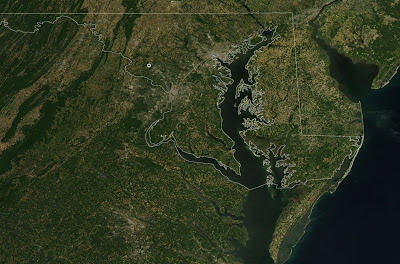
A small earthquake, centered in Germantown, Md. occurred at 5:04 a.m. EDT today, July 16, and its vibrations were felt from West Virginia to Bridgeport, Conn. NASA's Goddard Space Flight Center located in Greenbelt, Md., lies about 25 miles east-southeast of today's small earthquake and reported no damages. In fact, there were no reports of damage throughout Maryland. The earthquake registered 3.6 on the Richter scale, according to the U.S. Geological Survey (USGS), the agency that monitors quakes around the U.S.
USGS reported that the quake occurred today, Friday, July 16, 2010 at 5:04:47 a.m. EDT. The quake originated 5 kilometers deep and it was centered at 39.167°North, 77.252°West, in Germantown, Md. That latitude and longitude positions the quake's epicenter just west of Interstate 270 and south of Maryland state route 119. The USGS noted that the epicenter was 15 km of Rockville, Md., 30 km -northeast of Leesburg, Va., 35 km of Washington, D.C., and 70 km northwest of Annapolis, Md.
The USGS has a website where you can even report what you felt during earthquake events and view a map displaying accumulated data from your report and others. Go to: http://earthquake.usgs.gov/earthquakes/dyfi/events/us/2010yua6/us/index.html.Although earthquakes are monitored by the U.S. Geological Survey, NASA conducts research in various earthquake projects. That research is done in earthquake country, however, at NASA's Jet Propulsion Laboratory in Pasadena, Calif., just outside of Los Angeles.

NASA and Microsoft Research are bringing Mars to life with new features in the WorldWide Telescope software that provide viewers with a high-resolution 3-D map of the Red Planet. Microsoft's online virtual telescope explores the universe using images NASA spacecraft return from other worlds. Teams at NASA's Ames Research Center in Moffett Field, Calif., and Microsoft in Redmond, Wash., jointly developed the software necessary to make NASA's planetary data available in WorldWide Telescope.
"By providing the Mars dataset to the public on the WorldWide Telescope platform, we are enabling a whole new audience to experience the thrill of space," said Chris C. Kemp, chief technology officer for information technology at NASA Headquarters in Washington. The fully-interactive images and new NASA data will allow viewers to virtually explore Mars and make their own scientific discoveries. New features include the highest resolution fully interactive map of Mars ever created, realistic 3-D renderings of the surface of the planet and video tours with two NASA scientists, James Garvin of NASA's Goddard Space Flight Center in Greenbelt, Md., and Carol Stoker of Ames.
Garvin's tour walks viewers through the geological history of Mars and discusses three possible landing sites for human missions there. Each landing site highlights a different geological era of the planet. Stoker's tour addresses the question "Is there life on Mars?" and describes the findings of NASA's Mars Phoenix Lander. "Our hope is that this inspires the next generation of explorers to continue the scientific discovery process," said Ames Center Director S. Pete Worden.

The Ares I-X flight test in 2009 met all its primary goals and provided a solid foundation for future rockets, the engineers who designed the rocket and oversaw the launch said during a recent presentation at NASA's Kennedy Space Center in Florida. "The rocket just performed beautifully," Deputy Mission Manager Jon Cowart told a group that included engineers who will be counted on to develop future launch vehicles. "Certainly one of the coolest things I have done," he said.
Although the Ares I-X comprised a four-segment solid rocket booster as a first stage and was topped with a dummy fifth segment and upper stage, the results showed the design is solid, Ares I-X officials said. "It wasn't just good for designing an Ares rocket," Cowart said, "it was good for designing rockets in general." The launch on Oct. 28, 2009, from Kennedy's Launch Pad 39B answered a great deal of fundamental questions about the rocket's performance and aerodynamic design.
For example, Chris Calfee of Marshall Space Flight Center said the telemetry gave engineers a good look at the thrust oscillations the booster would experience during ascent. Calfee served as the first stage Integrated Product Team leader for the Ares I-X. "We're confident that's not the problem we first thought it would be," he said. The rocket was lined with more than 700 sensors that gave engineers enough data to compare with predictions made by computer models.


