
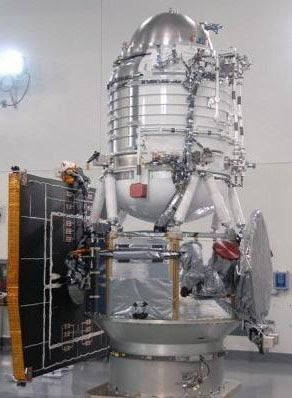
Astronomers across the globe can now sift through hundreds of millions of galaxies, stars and asteroids collected in the first bundle of data from NASA's Wide-field Infrared Survey Explorer (WISE) mission. "Starting today thousands of new eyes will be looking at WISE data, and I expect many surprises," said Edward (Ned) Wright of UCLA, the mission's principal investigator. WISE launched into space on Dec. 14, 2009 on a mission to map the entire sky in infrared light with greatly improved sensitivity and resolution over its predecessors. From its polar orbit, it scanned the skies about one-and-a-half times while collecting images taken at four infrared wavelengths of light. It took more than 2.7 million images over the course of its mission, capturing objects ranging from faraway galaxies to asteroids relatively close to Earth.
Like other infrared telescopes, WISE required coolant to chill its heat-sensitive detectors. When this frozen hydrogen coolant ran out, as expected, in early October, 2010, two of its four infrared channels were still operational. The survey was then extended for four more months, with the goal of finishing its sweep for asteroids and comets in the main asteroid belt of our solar system. The mission's nearby discoveries included 20 comets, more than 33,000 asteroids between Mars and Jupiter, and 133 near-Earth objects (NEOs), which are those asteroids and comets with orbits that come within 28 million miles of Earth's path around the sun. The satellite went into hibernation in early February of this year.
Today, WISE is taking the first major step in meeting its primary goal of delivering the mission's trove of objects to astronomers. Data from the first 57 percent of the sky surveyed is accessible through an online public archive. The complete survey, with improved data processing, will be made available in the spring of 2012. A predecessor to WISE, the Infrared Astronomical Satellite, served a similar role about 25 years ago, and those data are still valuable to astronomers today. Likewise, the WISE legacy is expected to endure for decades. "We are excited that the preliminary data contain millions of newfound objects," said Fengchuan Liu, the project manager for WISE at NASA's Jet Propulsion Laboratory, Pasadena, Calif. "But the mission is not yet over the real treasure is the final catalog available a year from now, which will have twice as many sources, covering the entire sky and reaching even deeper into the universe than today's release."

This oddly colorful nebula is the supernova remnant IC 443 as seen by NASA's Wide-field Infrared review Explorer, or WISE. Also known as the Jellyfish nebula, IC 443 is mainly interesting because it provides a look into how stellar explosions relate with their environment. IC 443 can be found near the star Eta Geminorum, which lies near Castor, one of the twins in the group Gemini. Just like human beings, stars have a life cycle they are born, mature and finally die. The way in which stars die depends on their mass. Stars with mass alike to the sun characteristically become planetary nebulae at the end of their lives, whereas stars with many times the sun's collection explode as supernovae.
IC 443 is the remains of a star that go supernova somewhere between 5,000 and 10,000 years ago. The explosion from the supernova sent out shock waves that travel through space, sweeping up and heating the nearby gas and dust in the interstellar medium, and creating the supernova remnant seen in this image. What is unusual about the IC 443 is that its shell-like form has two halve that have dissimilar radii, structures and emissions. The better northeastern shell, seen here as the violet colored semi circle on the top left of the supernova remainder, is composed of sheet like filaments that are emit light from iron, neon, silicon and oxygen gas atoms, in addition to dust particle, all heated by the blast from the supernova.
The smaller southern shell, seen here in a bright cyan color on the base half of the image, is constructed of denser clumps and knots chiefly emitting light from hydrogen gas and heated dust. These clumps are division of a molecular cloud, which can be seen in this image as the greenish cloud hurtful across IC 443 from the northwest to southeast. The color differences seen in this image represent dissimilar wavelengths of infrared emission. The differences in color are also the result of difference in the energies of the shock influence hitting the interstellar medium. The northeastern shell was most likely shaped by a fast shock wave, whereas the southern shell was perhaps created by a slow shock wave.

NASA's Wide-field Infrared Survey Explorer, or WISE, caught a glimpse of the comet that the agency's EPOXI mission will visit in November. The WISE observation will help the EPOXI team put together a large-scale picture of the comet, known as Hartley 2. "WISE's infrared vision provides data that complement what EPOXI will see with its visible-light and near-infrared instruments," said James Bauer, of NASA's Jet Propulsion Laboratory, Pasadena, Calif. "It's as if WISE can see an entire country, and EPOXI will visit its capital." WISE's infrared vision will allow the telescope to get a new estimate of the size of the comet's nucleus, or core, as well as a more thorough look at the sizes of dust particles that surround it. This information, when combined with what EPOXI finds as it gets closer to Hartley 2, will reveal how the comet has changed over time.
On Nov. 4, the EPOXI mission, which uses the already "in flight" Deep Impact flyby spacecraft, will reach its closet approach to Hartley 2. The spacecraft will examine the dusty, icy body in detail as it flies by, providing the best, extended view of a comet in history. WISE and several other ground- and space-based telescopes are participating in the viewing, working together to tackle mysteries about our solar system's origins that are frozen inside comets. For stargazers, opportunities to view the comet are possible throughout October. On Wednesday, Oct. 20, Hartley 2 will reach its closest approach to Earth since it was discovered in 1986. The comet will be approximately 11 million miles away and should be visible with the naked eye near the constellation Perseus if viewed in dark skies.
Observers will need binoculars or telescopes from urban areas in the Northern Hemisphere. Southern Hemisphere stargazers can see the comet later in the month. WISE captured its view of the comet during an ongoing scan of the sky in infrared light. The mission has been busy cataloging hundreds of millions of objects, from comets to distant, powerful galaxies. In late September, it used up its frozen cryogen coolant as expected and began a new phase of its survey. Called the NEOWISE Post-Cryogenic Mission, it primarily focuses on finding additional asteroids and comets. To date, the WISE mission has observed more than 150,000 asteroids and 110 comets, including Hartley 2.
 Unicorns and roses are usually the stuff of fairy tales, but a new cosmic image taken by NASA's Wide-field Infrared Explorer (WISE) shows the Rosette nebula located within the constellation Monoceros, or the Unicorn. This flower-shaped nebula, also known by the less romantic name NGC 2237, is a huge star-forming cloud of dust and gas in our Milky Way galaxy. Estimates of the nebula's distance vary from 4,500 to 5,000 light-years away. At the center of the flower is a cluster of young stars called NGC 2244. The most massive stars produce huge amounts of ultraviolet radiation, and blow strong winds that erode away the nearby gas and dust, creating a large, central hole.
The radiation also strips electrons from the surrounding hydrogen gas, ionizing it and creating what astronomers call an HII region. Although the Rosette nebula is too faint to see with the naked eye, NGC 2244 is beloved by amateur astronomers because it is visible through a small telescope or good pair of binoculars. The English astronomer John Flamsteed discovered the star cluster NGC 2244 with a telescope around 1690, but the nebula itself was not identified until John Herschel observed it almost 150 years later. The streak seen at lower left is the trail of a satellite, captured as WISE snapped the multiple frames that make up this view.
This image is a four-color composite created by all four of WISE's infrared detectors. Color is representational: blue and cyan represent infrared light at wavelengths of 3.4 and 4.6 microns, which is dominated by light from stars. Green and red represent light at 12 and 22 microns, which is mostly light from warm dust. JPL manages the Wide-field Infrared Survey Explorer for NASA's Science Mission Directorate, Washington. The principal investigator, Edward Wright, is at UCLA. The mission was competitively selected under NASA's Explorers Program managed by the Goddard Space Flight Center, Greenbelt, Md. The science instrument was built by the Space Dynamics Laboratory, Logan, Utah, and the spacecraft was built by Ball Aerospace & Technologies Corp., Boulder, Colo.
Unicorns and roses are usually the stuff of fairy tales, but a new cosmic image taken by NASA's Wide-field Infrared Explorer (WISE) shows the Rosette nebula located within the constellation Monoceros, or the Unicorn. This flower-shaped nebula, also known by the less romantic name NGC 2237, is a huge star-forming cloud of dust and gas in our Milky Way galaxy. Estimates of the nebula's distance vary from 4,500 to 5,000 light-years away. At the center of the flower is a cluster of young stars called NGC 2244. The most massive stars produce huge amounts of ultraviolet radiation, and blow strong winds that erode away the nearby gas and dust, creating a large, central hole.
The radiation also strips electrons from the surrounding hydrogen gas, ionizing it and creating what astronomers call an HII region. Although the Rosette nebula is too faint to see with the naked eye, NGC 2244 is beloved by amateur astronomers because it is visible through a small telescope or good pair of binoculars. The English astronomer John Flamsteed discovered the star cluster NGC 2244 with a telescope around 1690, but the nebula itself was not identified until John Herschel observed it almost 150 years later. The streak seen at lower left is the trail of a satellite, captured as WISE snapped the multiple frames that make up this view.
This image is a four-color composite created by all four of WISE's infrared detectors. Color is representational: blue and cyan represent infrared light at wavelengths of 3.4 and 4.6 microns, which is dominated by light from stars. Green and red represent light at 12 and 22 microns, which is mostly light from warm dust. JPL manages the Wide-field Infrared Survey Explorer for NASA's Science Mission Directorate, Washington. The principal investigator, Edward Wright, is at UCLA. The mission was competitively selected under NASA's Explorers Program managed by the Goddard Space Flight Center, Greenbelt, Md. The science instrument was built by the Space Dynamics Laboratory, Logan, Utah, and the spacecraft was built by Ball Aerospace & Technologies Corp., Boulder, Colo.
View this site :
Property auctions

NASA's Wide-field Infrared Survey Explorer, or WISE, is warming up. Team members say the spacecraft is running out of the frozen coolant needed to keep its heat-sensitive instrument chilled.The telescope has two coolant tanks that keep the spacecraft's normal operating temperature at 12 Kelvin. The outer, secondary tank is now depleted, causing the temperature to increase. One of WISE's infrared detectors, the longest-wavelength band most sensitive to heat, stopped producing useful data once the telescope warmed to 31 Kelvin. The primary tank still has a healthy supply of coolant, and data quality from the remaining infrared detectors remains high.
WISE completed its primary mission, a full scan of the entire sky in infrared light, on July 17, 2010. The mission has taken more than 1.5 million snapshots so far, uncovering hundreds of millions of objects, including asteroids, stars and galaxies. It has discovered more than 29,000 new asteroids to date, more than 100 near-Earth objects and 15 comets. WISE is continuing a second survey of about one-half the sky as originally planned. It's possible the remaining coolant will run out before that scan is finished. Scientists say the second scan will help identify new and nearby objects, as well as those that have changed in brightness. It could also help to confirm oddball objects picked up in the first scan.
NASA's Jet Propulsion Laboratory, Pasadena, Calif., manages the Wide-field Infrared Survey Explorer for NASA's Science Mission Directorate, Washington. The principal investigator, Edward Wright, is at UCLA. The mission was competitively selected under NASA's Explorers Program, managed by the Goddard Space Flight Center, Greenbelt, Md. The science instrument was built by the Space Dynamics Laboratory, Logan, Utah, and the spacecraft was built by Ball Aerospace & Technologies Corp., Boulder, Colo. Science operations and data processing take place at the Infrared Processing and Analysis Center at the California Institute of Technology in Pasadena. Caltech manages JPL for NASA.
NASA's Wide-field Infrared Survey Explorer, or WISE, will complete its first survey of the entire sky on July 17. The mission has generated more than one million images so far, of everything from asteroids to distant galaxies. "Like a globe-trotting shutterbug, WISE has completed a world tour with 1.3 million slides covering the whole sky," said Edward Wright, the principal investigator of the mission at the University of California, Los Angeles.
Some of these images have been processed and stitched together into a new picture being released today. It shows the Pleiades cluster of stars, also known as the Seven Sisters, resting in a tangled bed of wispy dust. The pictured region covers seven square degrees, or an area equivalent to 35 full moons, highlighting the telescope's ability to take wide shots of vast regions of space.
The new picture was taken in February. It shows infrared light from WISE's four detectors in a range of wavelengths. This infrared view highlights the region's expansive dust cloud, through which the Seven Sisters and other stars in the cluster are passing. Infrared light also reveals the smaller and cooler stars of the family.

Some might see a blood-red jellyfish in a forest of seaweed, while others might see a big, red eye or a pair of lips. In fact, the red-colored object in this new infrared image from NASA's Wide-field Infrared Survey Explorer (WISE) is a sphere of stellar innards, blown out from a humongous star.
The star (white dot in center of red ring) is one of the most massive stellar residents of our Milky Way galaxy. Objects like this are called Wolf-Rayet stars, after the astronomers who found the first few, and they make our sun look puny by comparison. Called V385 Carinae, this star is 35 times as massive as our sun, with a diameter nearly 18 times as large. It's hotter, too, and shines with more than one million times the amount of light.
Fiery candles like this burn out quickly, leading short lives of only a few million years. As they age, they blow out more and more of the heavier atoms cooking inside them -- atoms such as oxygen that are needed for life as we know it.


