
The Mid-Atlantic Regional Spaceport will be the launch site later this spring for a Minotaur rocket carrying into orbit ORS-1, a military observation satellite that is the first operationally reactive space satellite designed to support combat operations. Some 50 tourism representatives from three states were brief at Wright's Restaurant in Atlantic about the Department of Defense mission. This will be the 4th Minotaur rocket launched from Wallops. The launch will occur in May or June, Valerie Skarupa, chief of policy and strategic communications for the Department of Defense's operationally reactive Space Office, said. The correct date has not yet been set, according to NASA Wallops Flight Facility spokesman Keith Kohler.
The Operationally Responsive Space office, located at Kirtland Air Force Base, was authorization by the President and Congress and created in May 2007 to focus on meeting joint force commanders' wants quickly and flexibly. "The way we had addressed threats had changed," Skarupa said, addition the objective now is "to be more agile and resilient," including a shift to using lesser satellites with shorter lifespans and to a "plug-and-play" type modular open systems approach to given that communications and imaging satellites for military use with the eventual goal being to be capable to assemble and launch a satellite within days to weeks.
Skarupa, who was involved in the last two military launches from Wallops, praised the ability as "accurate and fast" and said the inclination angle for launches from Wallops "is perfect for the wars we have going on today." Skarupa also called the TacSat-3 satellite launched from Wallops in May 2009 "a enormous success," noting that the research and development satellite went into use for real operations in 2010. Julie Mears, marketing communications director for Goodrich ISR Systems, the British company that built ORS-1 in Danbury, Ct., also spoke at the tourism meeting, as did Vicki Cox, senior communications manager for ATK Aerospace Systems, which construct the modular bus for the ORS-1 payload in Beltsville, Md. The company also construct the bus for TacSat-3.
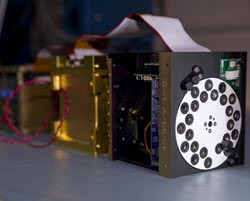
More than one hundred days ago, on Nov. 19, 2010, NASA sent a small satellite about the size of a loaf of bread on an important mission to answer astrobiology’s fundamental questions about the origin, evolution and distribution of life in the universe. Since then, the nanosatellite, known as Organism/Organic Exposure to Orbital Stresses (O/OREOS) continues on its quest, which has taken it just about everywhere between the Arctic and Antarctic Circles more than 400 miles above Earth's surface. O/OREOS weighs approximately 12 pounds and is NASA’s first CubeSat to demonstrate the capability to have two distinct, completely independent science experiments on a single autonomous satellite.
O/OREOS is using NASA’s first propellant-less mechanism on a scientific satellite to ensure it de-orbits and burns up as it re-enters Earth’s atmosphere, less than 25 years after completing its mission. It's also the first nanosatellite to not only operate, but also conduct autonomous biological and chemical measurements, in the region of space known as the exosphere. "The fact that we're getting consistently good science data in such a challenging environment tells us that secondary payload nanosatellites like O/OREOS can be made rugged enough to enhance our opportunities to conduct research in low Earth orbit," said Antonio Ricco, instrument scientist for O/OREOS and a researcher at NASA's Ames Research Center, Moffett Field, Calif. "This is enabling us to study organics, microorganisms, and astrobiology in the space environment in real time."
O/OREOS was a secondary payload aboard a U.S. Air Force four-stage Minotaur IV rocket launched from the Alaska Aerospace Corporation’s Kodiak Launch Complex on Kodiak Island, Alaska. After O/OREOS separated from the rocket and successfully entered low Earth orbit, it activated and began transmitting radio signals to ground control stations and spacecraft operators in the mission control center at Santa Clara University, Santa Clara, Calif. Nearly daily two-way communications with the spacecraft provided valuable information about its health, status and science data, and have given scientists the ability to fine tune the science payloads’ operating parameters.
 The federal Labor government has secretly hosted US military group supporting the operation of new ballistic missile defence satellites while trying to dodge a backlash on the matter from the party's Left faction. The Defence Department has established that two elite teams from the US Air Force, and satellite tracking and communications equipment, were deployed in Australia in 2009 to give communication links to two new Space Tracking Surveillance System (STSS) satellites. In what was codenamed Project Crok, personnel from the USAF space test group/space test action squadron were deploy from Kirtland Air Force Base in New Mexico to HMAS Stirling south of Perth and Fort Direction near Hobart.
The US teams worked in Australia for more than two months to support the primary operations of two STSS satellites launch from Cape Canaveral on September 25, 2009. Details of the co operation have been out in secret US embassy cables get by WikiLeaks and provided exclusively to The Age. According to the US Air Force, the space test process squadron uses "highly mobile ground systems or particularly designed maritime platforms" to offer "telemetry, tracking and commanding from locations worldwide" in support of the testing and evaluation of US military space systems. Built by aerospace giant Northrop Grumman, the low-earth orbiting STSS satellites sense ballistic missile launches using infrared sensors.
They are intended to complement US geostationary early warning satellites with advanced capabilities to sense and track ballistic missiles during the boost and midcourse phases of flight, ''substantially improving the presentation of ballistic missile defences''. In some trials conduct last year, the two expression STSS satellites successfully detected "threat-representative" missiles launched from Vandenberg Air Force Base in California and communicate "trajectory data" to US ballistic missile defence ground stations. Federal Labor's contract to host Project Crok followed briefings of US embassy official by then Defence Department deputy secretary Mike Pezzullo on the government's missile defence policy.

Travelers over the long holiday weekend can count on one Christmas present: great satellite data from the GOES series of satellites to help them in their travels. Data from the GOES-13 and GOES-11 satellites were used to create a full image of the continental U.S. on Dec. 23 at 1145 UTC (6:45 a.m. EST) as travelers make their way across the country to their holiday destinations. GOES-13 and GOES-11 are the Geostationary Operational Environmental Satellites that monitor the nation's weather for the U.S. GOES satellites are operated by NOAA, and images and animations are created at the NASA GOES Project at NASA's Goddard Space Flight Center in Greenbelt, Md.
The GOES-11 satellite is stationary over the western U.S. and provides imagery of that half of the country in addition to visible and infrared images of the eastern and central Pacific Oceans. GOES-13 covers the eastern half of the nation and the Atlantic Ocean. The holiday travel image combines data from both of these satellites. The image showed a large area clouds from the U.S. southwest stretching north. Those clouds are associated with a low pressure area currently over Colorado. The storm system affecting the Southwest is forecast to move eastward and slide off the coast. It could then track north along the coast and bring some heavy winter weather to coastal areas from the Carolinas northward. Travel could be affected particularly Sunday and Monday along the U.S. East coast from this storm system.
NOAA will be tracking the storm and issuing forecasts over the weekend as the low moves. On Thursday, Dec. 23, the GOES image showed clouds over eastern New England that are associated with a low already out to sea and taking rain with it. In the upper Midwest and Southern Plains states a short wave of energy is going through the region. Some snow showers are forecast for Thursday night, Friday and Saturday in Milwaukee, Wisconsin. Snow is forecast in Kansas City, Missouri on Friday, while some sun and flurries are expected on Christmas day. Areas of the Midwest should also be on guard for freezing rain, sleet and snow over the weekend.


