Showing posts with label neutron star. Show all posts

NASA's RXTE Captures Thermonuclear Behavior of Unique Neutron Star

Neutron Star


A neutron star is the closest thing to a black hole that astronomers can observe directly, crushing half a million times more mass than Earth into a sphere no larger than a city. In October 2010, a neutron star near the center of our galaxy erupted with hundreds of X-ray bursts that were powered by a barrage of thermonuclear explosions on the star's surface. NASA's Rossi X-ray Timing Explorer (RXTE) captured the month-long fusillade in extreme detail. Using this data, an international team of astronomers has been able to bridge a long-standing gap between theory and observation.

"In a single month from this unique system, we have identified behavior not seen in observations of nearly 100 bursting neutron stars during the past 30 years," said Manuel Linares, a postdoctoral researcher at the Kavli Institute for Astrophysics and Space Research at the Massachusetts Institute of Technology in Cambridge. He led a study of the RXTE data that will be published in the March 20 issue of The Astrophysical Journal.


On Oct. 10, 2010, the European Space Agency's INTEGRAL satellite detected a transient X-ray source in the direction of Terzan 5, a globular star cluster about 25,000 light-years away toward the constellation Sagittarius. The object, dubbed IGR J17480–2446, is classed as a low-mass X-ray binary system, in which the neutron star orbits a star much like the sun and draws a stream of matter from it. As only the second bright X-ray source to be found in the cluster, Linares and his colleagues shortened its moniker to T5X2.

Remnant of an Explosion With a Powerful Kick?

Remnant Explosion

Vital clues about the devastating ends to the lives of massive stars can be found by studying the aftermath of their explosions. In its more than twelve years of science operations, NASA's Chandra X-ray Observatory has studied many of these supernova remnants sprinkled across the Galaxy. The latest example of this important investigation is Chandra's new image of the supernova remnant known as G350.1+0.3. This stellar debris field is located some 14,700 light years from the Earth toward the center of the Milky Way.

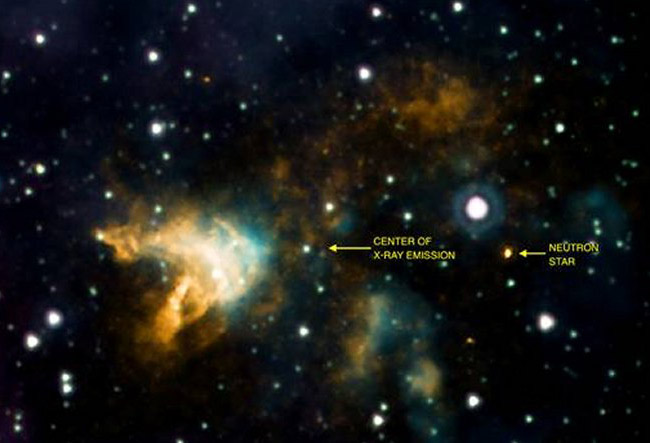
Evidence from Chandra and from ESA's XMM-Newton telescope suggest that a compact object within G350.1+0.3 may be the dense core of the star that exploded. The position of this likely neutron star, seen by the arrow pointing to "neutron star" in the inset image, is well away from the center of the X-ray emission. If the supernova explosion occurred near the center of the X-ray emission then the neutron star must have received a powerful kick in the supernova explosion.

Data from Chandra and other telescopes suggest this supernova remnant, as it appears in the image, is between 600 and 1,200 years old. If the estimated location of the explosion is correct, this means that the neutron star has been moving at a speed of at least 3 million miles per hour since the explosion This is comparable to the exceptionally high speed derived for the neutron star in Puppis A, another neutron star moving at a blistering pace within a supernova remnant. The G350+1+0.3 data provide new evidence that extremely powerful "kicks" may be imparted to neutron stars left behind once the supernova has exploded.


NASA's Fermi Finds Youngest Millisecond Pulsar, 100 Pulsars To-Date

NASA Fermi

An international team of scientists using NASA's Fermi Gamma-ray Space Telescope has discovered a surprisingly powerful millisecond pulsar that challenges existing theories about how these objects form.At the same time, another team has located nine new gamma-ray pulsars in Fermi data, using improved analytical techniques.

A pulsar is a type of neutron star that emits electromagnetic energy at periodic intervals. A neutron star is the closest thing to a black hole that astronomers can observe directly, crushing half a million times more mass than Earth into a sphere no larger than a city. This matter is so compressed that even a teaspoonful weighs as much as Mount Everest.

"With this new batch of pulsars, Fermi now has detected more than 100, which is an exciting milestone when you consider that, before Fermi's launch in 2008, only seven of them were known to emit gamma rays," said Pablo Saz Parkinson, an astrophysicist at the Santa Cruz Institute for Particle Physics at the University of California Santa Cruz, and a co-author on two papers detailing the findings.