Showing posts with label California Institute of Technology. Show all posts

Study Finds Surprising Arctic Methane Emission Source

Arctic Methane

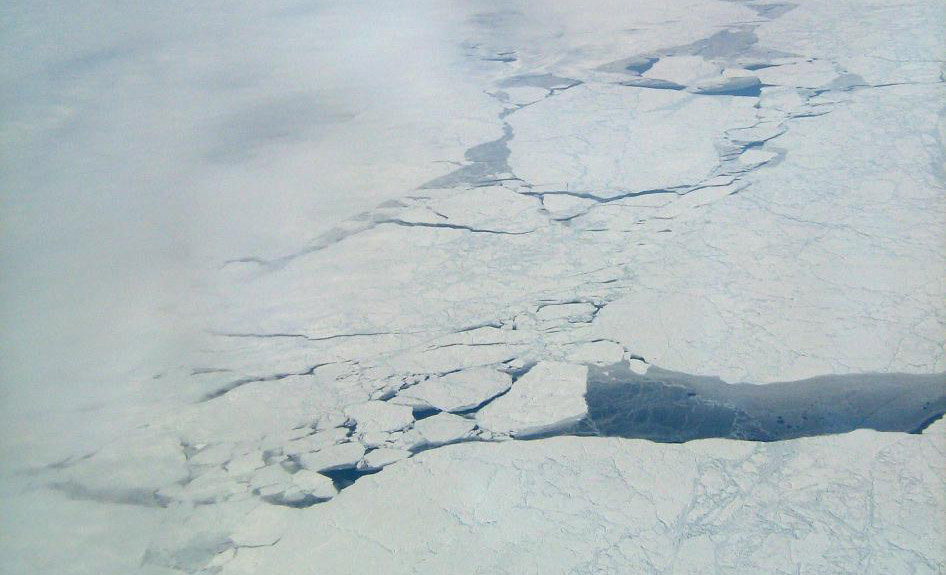
The fragile and rapidly changing Arctic region is home to large reservoirs of methane, a potent greenhouse gas. As Earth’s climate warms, the methane, frozen in reservoirs stored in Arctic tundra soils or marine sediments, is vulnerable to being released into the atmosphere, where it can add to global warming. Now a multi-institutional study by Eric Kort of NASA’s Jet Propulsion Laboratory, Pasadena, Calif., has uncovered a surprising and potentially important new source of Arctic methane: the ocean itself.

Kort, a JPL postdoctoral scholar affiliated with the Keck Institute of Space Studies at the California Institute of Technology in Pasadena, led the analysis while he was a student at Harvard University, Cambridge, Mass. The study was conducted as part of the HIAPER Pole-to-Pole Observations (HIPPO) airborne campaign, which flew a specially instrumented National Science Foundation (NSF)/National Center for Atmospheric Research (NCAR) Gulfstream V aircraft over the Pacific Ocean from nearly pole to pole, collecting atmospheric measurements from Earth’s surface to an altitude of 8.7 miles (14 kilometers).

The campaign, primarily funded by NSF with additional funding from NCAR, NASA and the National Oceanic and Atmospheric Administration, was designed to improve our understanding of where greenhouse gases are originating and being stored in the Earth system. During five HIPPO flights over the Arctic from 2009 to 2010, Kort’s team observed increased methane levels while flying at low altitudes over the remote Arctic Ocean, north of the Chukchi and Beaufort Seas. The methane level was about one-half percent larger than normal background levels.

Useful Links: Twins Moving, Town, Movers USA

NASA's Voyager Hits New Region at Solar System Edge

Solar System

NASA's Voyager 1 spacecraft has entered a new region between our solar system and interstellar space. Data obtained from Voyager over the last year reveal this new region to be a kind of cosmic purgatory. In it, the wind of charged particles streaming out from our sun has calmed, our solar system's magnetic field has piled up, and higher-energy particles from inside our solar system appear to be leaking out into interstellar space.

"Voyager tells us now that we're in a stagnation region in the outermost layer of the bubble around our solar system," said Ed Stone, Voyager project scientist at the California Institute of Technology in Pasadena. "Voyager is showing that what is outside is pushing back. We shouldn't have long to wait to find out what the space between stars is really like."

Although Voyager 1 is about 11 billion miles (18 billion kilometers) from the sun, it is not yet in interstellar space. In the latest data, the direction of the magnetic field lines has not changed, indicating Voyager is still within the heliosphere, the bubble of charged particles the sun blows around itself. The data do not reveal exactly when Voyager 1 will make it past the edge of the solar atmosphere into interstellar space, but suggest it will be in a few months to a few years.


Space Observatory Provides Clues to Creation of Earth's Oceans

Space Observatory

Astronomers have found a new cosmic source for the same kind of water that appeared on Earth billions of years ago and created the oceans. The findings may help explain how Earth's surface ended up covered in water.

New measurements from the Herschel Space Observatory show that comet Hartley 2, which comes from the distant Kuiper Belt, contains water with the same chemical signature as Earth's oceans. This remote region of the solar system, some 30 to 50 times as far away as the distance between Earth and the sun, is home to icy, rocky bodies including Pluto, other dwarf planets and innumerable comets.

"Our results with Herschel suggest that comets could have played a major role in bringing vast amounts of water to an early Earth," said Dariusz Lis, senior research associate in physics at the California Institute of Technology in Pasadena and co-author of a new paper in the journal Nature, published online today, Oct. 5. "This finding substantially expands the reservoir of Earth ocean-like water in the solar system to now include icy bodies originating in the Kuiper Belt.